Diposkan oleh
Pengetahuan dan Pengalaman on Wednesday, September 14, 2011
Shorts, short-sleeve T-shirts, no masks, sneakers, with small kids. (In other words, all the things you should never do.)
As "decontamination" is set to become a new bubble for Fukushima Prefecture if not for entire Japan, the national government strongly encourage citizen volunteers to "decontaminate" their own neighborhood.
So, one elementary school in Tsukuba City in Ibaraki Prefecture called on the parents to do the "decontamination" of the school yard on September 9, and Ibaraki City proudly posted the photographs of the occasion on its webpage.
Except... oops one of the photos showed the presence of small children. It was supposed to be done by adult volunteers only, for the safety for the kids. People started to question the wisdom of "decon" with children, so the city quietly substituted the photo with the one without any children in it.
What were these parents thinking? Well I guess they couldn't secure babysitters. Or they thought this was some kind of family fun activity. Probably the answer was that they weren't thinking.
Professor Hayakawa of Gunma Prefecture (of radiation contour map fame) is one of those people who happened to capture the photo before Tsukuba deleted from its site:
Not only you see children, but the parents are seen in shorts, T-shirts, no masks, no protective gear. They have rakes, shovels and brooms as tools. Tsukuba City's webpage shows houses right next to the school yard. (I bet they were not too happy to see the dust flying up from the operation.)
The website of this particular school proudly announces the radiation level decreased by 0.002 to 0.01 microsievert/hour for the school yard. The radiation level dropped by two-third in ditches and under the rain gutters by removing the dirt.
Why did the school do this nearly useless "decontamination" which hardly reduced the radiation level except under the gutters and in the ditches? Probably to "alleviate fear and anxiety" among parents, as every single politician and bureaucrat in Japan spouts these days. Now the school is all set for its annual autumn school athletic meet.
It's all in your head, they say.
I still occasionally see some tweets by people from high radiation areas saying "We'll adapt to high radiation quickly, won't we? After all, there are locations in the world with 10 millisieverts/year radiation!" Well, according to Dr. Alexey Yablokov (link is PDF file), it takes about 20 generations or 400 years for people to become less sensitive to radiation effect.
A citizen's group (福島老朽原発を考える会) announced the result of the second testing of the 10 children in Fukushima City and other locations whose urine had been tested 2 months earlier. In one child who did not evacuate from Fukushima, the amount of radioactive cesium didn't decrease but increased slightly.
In May, the group asked a French laboratory to test the urine samples from 10 children from 6 to 16 years old. Radioactive cesium was detected from all samples. In the second test conducted at the end of July, the amount was lower, or in some cases not detected, in 9 children who evacuated from Fukushima Prefecture. However, from the urine sample of a 16-year-old boy who remained in Fukushima City, cesium-137 increased from 0.78 becquerels/liter in May to 0.87 becquerels/liter.
France's ACRO, who did the testing, has more details and harsh words for the Japanese government (emphasis is original):
Comments :
At the request of Japanese citizens, ACRO analyzed the urine of 18 Japanese children from the prefecture of Fukushima and from Tokyo and its surroundings.
All the 15children fromFukushimahave or had their urine contaminated with radioactive fallout from the nuclear accident located approximately 60 km away.This meansthat childrenthemselveshave been or arecontaminated. However, we did not detect anycontaminationin the urine of the threechildrenfrom Tokyoand surroundings.
Whilethe tests performed by the Japanese authoritiesgive about one child from Fukushima out two that is contaminated, we get 100%. This reflects thefact that theofficial measurementsare notaccurate enoughand didnot detectallcontaminations.
The first 10childrenare the same asin ourpreviousmeasurement campaign(resultsreleasedJune 30). 9of them haveleft the province ofFukushimasince.Only oneremained(U2). U6 child was evacuated in end of March. U3 and U4 children were evacuated in the end of May. 3 left late June, early July andthreeothers at the beginning of the school holidaysfromJuly 22.
Finally,fivenew childrenlivenearby Fukushima-city. One of them was evacuated in the middle of May (U14).
U11andU12 attendthe same high schoolwhere they frequently practice sports on the sameplayground.The difference in the contamination could be due tofood.
More than four monthsafter the massive dischargesof radioactivityinto the environment,all childrenstillin Fukushimaat the time of urine samplingwere contaminated, although their parents do their best to reduce this contamination. Evacuation isaway to reducecontamination. Variations in internal contamination between different children might be due to food.
Itis important to conductan accurate,systematic and regular monitoringof internal contaminationof children fromFukushima. Families must have access to the measurement of radioactivity to help them reduce this contamination.
Diposkan oleh
Pengetahuan dan Pengalaman on Tuesday, September 6, 2011
I just don't know what to say.
NHK's program "Close-up Gendai" aired the episode on August 31 (which you can view at the program's site here) about a 72-year-old obstetrician and over 50 pregnant mothers coming back to Minami Soma City to give birth.
The reason for coming back to their homes in Minami Soma City, even if the radiation level remains elevated, is that they were totally stressed out in the evacuation centers. When asked why she came back to the city, one young mother coming to see the obstetrician says, "Well, it was very cold sleeping on the hard floor of the gymnasium, and we thought our home would be better."
While the national government created the evacuation-ready zone in Minami Soma City and advised small children and pregnant women to stay out of the zone, there was no actual support as to where they, particularly pregnant women, can stay comfortably outside the zone.
NHK's program also makes it clear that Minami Soma City itself has no such plan. On the contrary, we know that the city is telling the residents to come back.
The obstetrician, Dr. Takahashi, was able to fit the mothers with glass badges that record the external radiation exposure, thanks to the donation of an NPO. After one month, he got the result. It was between 1 and 6.96 millisieverts on the annual basis - that is, if they stay where they are for one year.
"Is this safe? No one can say for sure, but it is probably safe. There's not enough data to show the effect of radiation below 100 millisieverts per year", the NHK narrator says.
Dr. Takahashi goes and measures the radiation levels at another home. "0.58 microsievert/hour outside, about half that inside". The narrator says, "At this level, the annual radiation exposure would be about 2.5 millisieverts, far below 20 millisieverts". The husband chimes in, as if to convince himself and his wife that it is OK to stay there, "So it is higher than 1 millisievert/year standard that they often talk about, but far less than 20 millisieverts".
After the Minami Soma segment, the guest commentator speaks. Associate Professor Mitsuyoshi Urashima of Jikei University School of Medicine says the following:
To begin with, there is no radiation safety standard for fetuses. So we cannot say it is definitely safe, but I consider [these numbers in the video] to be safe.
There are three reasons why I say this. First, the International Commission on Radiological Protection (ICRP) says the low radiation above 100 millisieverts [per year] will increase the risk for cancer, but below that level, particularly below 10 millisieverts/year, it is designated as ultra low radiation where there is no increase of cancer. Second, the levels of natural radiation vary. There is a place in the world where people are exposed to 10 millisieverts radiation per year.
Third, there was no risk of thyroid cancer for the fetuses in Chernobyl. There was no increased risk for thyroid cancer after the babies were born. So, if [the radiation exposure] is less than 10 millisieverts, I don't think they need to worry too much.
Experts like him still cite the 10 millisieverts/year location as if that's totally acceptable and safe for people in Fukushima, whose natural radiation exposure has been 1.4 millisievert/year, not to mention this 10 millisieverts/year includes internal exposure.
Experts like him (and the infamous Dr. Yamashita) always cite thyroid cancer, as if that's all people need to worry about.
I can't really blame these mothers for escaping the extremely uncomfortable evacuation centers where they have to sleep on the hard floor with no privacy. It's just too bad that they didn't have anyone who would take them in, outside Minami Soma, and that no one cared about them in the government, national or municipal.
The governments don't do anything, because pregnant women are not supposed to be there in the evacuation-ready zone...
Diposkan oleh
Pengetahuan dan Pengalaman on Monday, September 5, 2011
Professor Takeda of Chubu University has an unusual, short post on his blog for September 5. It's titled "A Girl Doesn't Talk..." and the following is my unauthorized, quick translation:
A girl doesn't talk...
She doesn't talk. With her clear eyes she looks at everything her mother does. At her side, a boy with bright eyes is excited with the train just passing by.
A middle-aged man shouts. Why can't I sell contaminated vegetables? I took great pains growing them. What about our livelihood?
The girl doesn't talk. She quietly eats her school lunch as it is served. Even if the vegetables are contaminated, she takes in the radioactive materials because she trusts adults.
The angry middle-aged man, with the help of the governor and the board of education, shipped the contaminated vegetables that were sold as foodstuff for the school lunches, and he made the living. The government and TEPCO pretended they didn't know, and the media was afraid to report.
The girl who didn't talk is now sick in bed. Who could have saved this girl who didn't talk?
Professor Takeda has his share of detractors and critics, but ever since March 11 he has consistently spoke against radiation exposure for children and adults and denounced the government (particularly Ministry of Education, Board of Education, and teachers), TEPCO and experts (particularly medical experts) for making light of the danger of radiation exposure. (See my post from May for his strong words to teachers.)
At Fukushima Daiichi Elementary School, children started arriving at 7AM. High radiation has been measured in certain areas in Fukushima City, and the measures to lower the radiation levels in the school yards and on the routes to schools [children usually walk to school] are being taken. But on the first day of the school, many children wore masks, and many parents drove their children to school to the front gate of the school.
During the start of the school ceremony, Principal Kazuaki Fukui greeted the children, saying "I am glad that you are all here in good health to start the fall semester. Enjoy your school life". In Fukushima Prefecture, 280,000 children younger than 15 years are to receive the glass badges to monitor radiation. After the ceremony, children received the badges from their classroom teachers, and were told to wear the badge from the neck on the way to and from school.
On receiving the badges, children said "I feel a bit safer now", or "it feels funny when I wear it around my neck". A teacher in charge of 6th graders said, "I feel sorry that children have to wear the glass badges, but I consider the badges as amulets that protect children. It looks to me that there are fewer children with sun tan this year, so I would like to have them play outdoors as much as possible."
DON'T!!! In the accompanying video at the NHK page, the teacher says he hopes "it will be the normal fall semester, just like last year".
Higher education doesn't necessarily mean higher intelligence, that's for sure. (Probably inversely correlated, when I look at Japan.) And trading on hope is not a viable strategy either.
Diposkan oleh
Pengetahuan dan Pengalaman on Wednesday, August 31, 2011
The showdown of some sort happened on August 17 in a meeting set up by the Fukushima Network for Saving Children from Radiation, between the 4 children from Fukushima Prefecture and the junior bureaucrats from the national government.
It was widely disseminated in Japan and abroad when that happened, and many people were rightly appalled at the pathetically bureaucratic answers of these bureaucrats (what else could you expect?) to the children.
Tokyo Brown Tabby translated the exchange and put the caption on the video. This is the first half of the event. The second half, where the officials answer the children, is being translated by Tabby and will be ready shortly.
Children were reported to be very disappointed and hurt by the non-answers from the bureaucrats, which were totally expected (or should have been expected by the organizers to begin with).
Personally I have a mixed feeling. This reminds me of the Fukushima peach PR campaign the other day by the Fukushima junior high school students on their school trip to Yokohama City. The fruit growers use children to push their belief (that what they produce is safe), and the non-profit organizations against nuclear power also use children to push their belief (that the government should do everything to protect Fukushima children from radiation).
And who are hurt by the negative response or experience? Children.
Diposkan oleh
Pengetahuan dan Pengalaman on Tuesday, August 30, 2011
Well, I have to defend the City somewhat, because by no means Yokohama is alone, even though it has most number of schools (158) in the country that served beef contaminated with radioactive cesium.
While the City fed kindergarteners and school children with domestic beef contaminated with radioactive cesium despite protests from the concerned parents, the cafeteria at Yokohama City Hall for the city employees and guests were serving beef imported from Australia.
6 elementary schools served radioactive beef 5 times, and 22 schools served it 4 times.
Radioactive summer school:
The City is determined to keep sending school children to the summer school in an elevated radiation area in Gunma Prefecture. The officials insist it is safe, because they are told it's safe. Never mind that nearby locations have levels like 0.50 microsievert/hour (official), and a citizen measured as high as 1.26 microsievert/hour in the very area that the children may go to.
Bringing water bottles to schools:
At least one (but there seem to be many) school allows children to carry water bottles if they want, but they have to leave their bottles in the school principal's office, and when they want to drink water they must come to the principal's office to drink.
This is bullying and harassment of children by the school principal. Quite an education.
Altering the official document:
The City's Board of Education has relented somehow to parents and the legislators like Mr. Ota and issued a notice to the parents whose children go to the public elementary schools in Yokohama City, telling them to consult their schools individually if they want to send their children to school with homemade lunch and water bottle. The hitch is that this notice were issued through schools. Some schools decided to white out the part about homemade lunch and water bottle, and added the contact information for the Board of Education if the parents have any questions.
Testing food items in school lunches:
Oh yes finally the City is doing, but one item per day. Apparently, the City informs the lunch preparation centers which food item is to be tested on a particular day.
One positive thing:
Some parents are actually yanking their children from schools, and have started home schooling.
The survey by the Ministry of Education and Science has revealed that 296 schools in 12 prefectures have used beef from cows suspected of radioactive cesium contamination. 2 schools used the beef whose cesium level exceeded the provisional safety limit. It is not considered the level of cesium in the meat will affect health, but the ministry is telling the schools to pay attention to information on shipping restriction on food items [due to radiation].
According to the ministry, as of August 9, the meat from the cows that may have eaten radioactive rice hay was used in school lunches in 278 elementary schools, junior high schools, high schools, and special education schools, and 18 kindergartens, in 20 cities and towns in Japan. 127 schools in Yokohama City used it, so did 53 schools and kindergartens in Gifu City [in Gifu Prefecture], and 30 schools and kindergartens in 4 cities in Miyagi Prefecture. The schools are mostly located in eastern Japan, but 40 schools in 4 cities in Mie, Shimane, Kagawa Prefectures also used the meat.
30 schools were able to test the remaining meat, and radioactive materials were detected at 8 schools. Of the 8 schools, two schools - a special education school for students with disabilities in Miyagi Prefecture and an elementary school in Chiba, had the meat that exceeded the provisional safety limit (500 becquerels/kg of radioactive cesium), testing 1,293 to 649 becquerels/kg. The municipalities say the amount of contaminated beef per person is small, and it won't affect the health.
In the meantime, the Food Safety Commission under the Cabinet Office is soliciting public comments (in Japanese alone please, says the Commission) on their detailed justification for their decision to set 100 millisieverts for life-time allowable radiation exposure for the Japanese. If you read their conclusion, you would think there would be no problem with any of the nuclides that have been released from the broken nuclear power plant in Fukushima. (More later.)
and want to bring clean water and vegetables as souvenir for their parents after the summer camp.
From the tweets by @s_kiyoe, who set up a summer camp (in Shizuoka Prefecture, I think, judging by the town's name but I could be wrong) for children in Fukushima Prefecture. The original tweets are in Japanese:
Our fun-filled summer camp was finally over. We all cried at parting, because they didn't want to go back, and we didn't want them to go back to Fukushima under the current situation. Many Fukushima children were collecting empty plastic bottles. They said they wanted to fill the bottles with clean, safe water that they drank at the camp and bring them to their parents.
The bus arrived at the temple [where the camp was held] to take the children back to Fukushima. We asked them, "Where would you like to go to buy souvenirs?" They answered "Please take us where we can buy locally-grown vegetables, not supermarkets." Safe vegetables for their families.
The last day of the camp. A child from Tokyo said to a child from Fukushima, "Now it's my turn to visit you in Fukushima!" The child from Fukushima suddenly looked serious and said "You'd better not come to Fukushima right now." How could this be allowed? These children went back to the very place they just told others not to go.
Diposkan oleh
Pengetahuan dan Pengalaman on Friday, August 5, 2011
Yokohama City officials, from the ex-Daiei CEO mayor on down, denied and refused to do anything about it since one of the city's assemblymen first raised the issue back in April of school lunches in the city using beef from cows that were possibly contaminated with radioactive materials. The officials asserted that any food items were "safe as long as they are sold in the marketplace". (See my post here for the assemblyman's effort with concerned citizens of Yokohama to force the city to stop the use of beef in school lunches.)
Now, the city's Board of Education finally admits that the city may have fed as many as 67,000 kids in elementary schools in the city with radioactive beef.
Yokohama City announced on August 5 that the meat from 19 cows in Fukushima, Miyagi, and Iwate that may have been fed with rice hay contaminated with radioactive cesium may have been used in school lunches at the city's 127 elementary schools (for about 67,000 pupils).
According to the Health and Education section of the city's Board of Education, the meat from 19 cows were used 12 times between April 19 and June 21 as the ingredient for school lunches. The testing for radioactive materials in the meat was never done, and the meat has probably been all consumed. The Health and Education section of the Board of Education says "We don't know if we can trace the meat at all."
25 to 40 grams of the meat was used per serving. The Board of Education says "Since it was a small amount, it's hard to believe it would affect the health."
Here we go again. Citizens of Yokohama, take down the names of the people who said this.
So, the concerned citizens in Yokohama was raising the issue since April, and the they were dead right. They raised the issue with the city, and the city refused to do anything. Why? They could have tested the meat in April, and could have stopped using it. Instead, they did nothing, forced kids to eat school lunches (many parents were upset with school principals refusing to allow home-made lunch). Too afraid to find out? Too cheap to test?
It was only July 11 that Yokohama City finally stopped using the beef for lunch, several days before the summer break. They switched to pork, as if pork were safe. (More than 10,000 pigs have been moved from Fukushima and scattered throughout Japan since April, and there is no way to trace the movement as there is no unique identification system for pigs.)
Needless to say, it is not just elementary schools. That's what the city officials have admitted to. School lunches for kindergartens and nursery schools, and for junior high schools, are also prepared in the city's facilities and distributed to these schools.
**************************************
UPDATE: Checking the Yokohama assemblyman's message board, it's just unreal what's going on there. And by no means Yokohama is unique in this. Some of what's happening:
The city is still intent on sending the school kids to the summer school in Nikko, in Tochigi Prefecture, where the radiation is high;
Many schools don't allow children to carry water bottles to schools, and say they have to drink tap water;
Many schools still don't allow home-made lunches, and one school demands the parents that they make exactly the same lunch as the school lunch if they insist on home-made lunch for their children. Some schools collect monthly lunch fees from the parents even if their children carry home-made lunches;
Schools are planning to have children do the yard cleanup after the summer break.
Parents, pull your children out of schools. Any school.
***********************************
UPDATE-2
The announcement from the city's Board of Education is here (in Japanese). It details which school ate what on which date from which cow (with ID number). If you are a parent in Yokohama and read Japanese, go to the link above and check what your child may have been fed.
The Board of Education can't help these misleading statements though:
現在までのところ、暫定規制値を超える放射性物質が検出されたとする報告はありません。
So far, there has been no report of detection of the radioactive materials exceeding the provisional safety limit.
Of course there isn't, because all the meat has been consumed and there's nothing left to test.
And obligatory reference to "Oh the radiation level from the beef is the same as one chest X-ray so it's no big deal."
It's really scary that these people are "educators". We know better, don't we, thanks in part to people like Professor Kodama (I've started the summary of his interview on August 5), who tells us that the number is irrelevant when assessing the risk of radiation; it's where the radionuclides go in the body and what specific effect they have at particular locations.
(H/T to "Nguyen_ducThuan", a reader of my Japanese blog and a concerned resident in Yokohama City, for the link to the Board of Education.)
Diposkan oleh
Pengetahuan dan Pengalaman on Wednesday, August 3, 2011
As ultra-hot spots exceeding 5 sieverts/hour are being discovered Fukushima I Nuclear Power Plant and as the situation of serious radiation contamination is finally starting to sink in, what do they do in Fukushima Prefecture?
Hold the annual high school cultural festival, gathering high school students from all over Japan to Fukushima, in cities where high-radiation hot spots have been discovered throughout, or highly radioactive rice hay/meat cow has been found, or both. In one of the cities, Fukushima City, cobalt-60 has been detected in the soil in a park.
Business as usual, extend and pretend that everything is back to normal. Radiation? What radiation?
The 35th All Japan High School Cultural Festival in Fukushima 2011 started, as scheduled, on August 3. A variety of events organized by the high school students (yes, students in Fukushima Prefecture had been so hard at work), with the help of teachers and administrators, will be held in cities like:
Fukushima City Koriyama City Sukagawa City Shirakawa City Aizu Wakamatsu City Kitakata City Minami Soma City Iwaki City
The event is organized by the Agency for Cultural Affairs and the Boards of Education in each city in Fukushima, both under the Ministry of Education and Science.
Asahi Shinbun, which is one of the special sponsors of the event, reports, with hardly a mention of the Fukushima I Nuke Plant accident or radiation contamination in Fukushima. All it says about radiation is that "some venues have been changed because of a concern for radiation level..." It's just a "concern", not the real thing:
The 35th Annual All Japan High School Cultural Festival in Fukushima 2011 started as scheduled on August 3. The event is organized by the Agency for Cultural Affairs and others and sponsored by companies including Asahi Shinbun. There was a doubt as to whether the event would be held because of the Fukushima nuclear plant accident, but now 12,600 high school students from all over the country come to Fukushima, and will compete in 15 events that include chorus, art and craft, game of "go", Japanese chess.
The Festival is dubbed as "intercollegiate for high-school cultural clubs". The organizing committee of students and teachers have been preparing for the Festival for over a year. Initially, 23 events were planned that 20,000 students would participate in. But after the March 11 earthquake/tsunami some of the event venues became the evacuation shelters, and there was a concern for the radiation level in the areas where the events would be held. As the result, some events have been canceled, or the venues have been changed to other locations.
The grand opening ceremony will be held in Aizu Wakamatsu City on August 4. 550 local high school students will participate in a play that will express their hope for the recovery of Fukushima. ◇
The Festival is supported by 3,200 high school students in Fukushima Prefecture who serve as the operating personnel for the organizing committee. They act as guides at the airport and at the major train stations, as well as helping set up the event venues, provide tea service, flower arrangements at the train stations and at the event venues.
At the Fukushima Airport, 4 students from Sukagawa High School greeted the plane flown in from Osaka. They had prepared themselves well with hypothetical questions and answers. They guided the participants from Hyogo Prefecture through the airport, explained how to get to the event venues. They sent off the Hyogo students with "We hope you'll do your best."
At JR Koriyama Station, two girls from Asaka Kaisei High School were waiting for the participants. One girl said, "So many people are coming from far away places to Fukushima, where much damage has been sustained. I'm nervous, but I will greet them with a smile."
Visiting for a few days in a high-radiation area is different from living in such an area, you would say. So?
There was a piece of news back in May which was very quickly buried. The news said that thousands of people received elevated radiation just by being in Fukushima Prefecture for a few days.
The organization "Safe Children of Fukushima" put up a Facebook page telling the high school students of the risk of radiation, and specific steps what they should do which include not going to Fukushima. The organization tells the students, "If you do go, take protective measures against radiation, and talk about the radiation risks with the students in Fukushima." It has a map showing the radiation measurement along the railway line - approaching Koriyama City and Fukushima City, the level goes up to that of radiation control areas in nuclear facilities.
No matter. The governor of Fukushima, Yuhei Sato, as the honorary chairman of the organizing committee, would never think of depriving Fukushima high school students of their once-in-a-lifetime opportunity of hosting this prestigious cultural event.
And why should he? He clearly doesn't even care for kindergarteners in Fukushima, as it turns out he was probably the one who wanted 20 millisieverts/year radiation limit for school children.
Diposkan oleh
Pengetahuan dan Pengalaman on Monday, August 1, 2011
possibly irradiating children as they planted flowers as part of school curriculum.
Ever since the March 11 start of the Fukushima I Nuke Plant accident, unthinking, order-following school teachers and administrators throughout Japan from kindergarten/nursery school on (with a few exceptions) have made small children:
pick tea leaves which turned out to be highly radioactive (in one case in Ibaraki, they made them eat the tempura made out of the leaves);
The leaf compost that may contain high concentration of radioactive materials have been sold in the Prefecture. On July 31, it was discovered that one elementary school and one junior high school used the total of 40 bags (14 liters per bag) of the compost. According to the Prefecture's agricultural division, the schools used it in planters to grow flowers. The division says it has instructed the schools to move the planters away from school children.
両校から県に29日に相談が寄せられ、判明した。県は校名は公表していない。
The schools contacted the Prefecture for advice on July 29. The names of the schools haven't been disclosed.
The compost was sold at at Cainz Home's 14 stores in Nagano Prefecture. According to the agricultural division of the Prefecture, the elementary school purchased 10 bags in late June and mixed it with potting soil to grow chrysanthemums in planters. The junior high school used 30 to 40 bags to grow flowers.
14,800 becquerels/kg of radioactive cesium have been detected from this compost, as tested by Tottori Prefecture. According to Cainz, 13,000 bags of the same compost had been sold in Nagano since the March 11 earthquake until July 27, when the company voluntarily stopped selling.
And from Shikoku Shinbun (local paper in Kagawa Prefecture in Shikoku, 8/1/2011):
Concerning the radioactive leaf compost made in Tochigi Prefecture that was used in the schools' cultivation classes at 3 elementary schools in Kagawa Prefecture, one of the schools, Showa Elementary School in Ayagawa-cho (Principal Masanori Nakatsuka) held a meeting with the parents on July 31 night. The school listened to the parents and decided to discard the leaf compost. After the meeting, teachers and school administrators contacted all parents by email and phone calls.
会には、保護者約35人が出席。中塚校長と杉村和則町教育長らが説明に立った。
35 parents attended the meeting, in which Principal Nakatsuka and Kazunori Sugimura, head of the town's Board of Education explained the situation.
Then, the principal explained what the school's cultivation class was, and how the school became aware of the problem [of the radioactive compost]. He also reported that 400 planters that used the leaf compost had been moved to a location that morning and the school cordoned off the place.
In Q&A session, parents said "We still worry even if you say there is no effect on health", and "It will be educational if we dispose it properly, and explain to our children at home and at school". The principal promised to dispose the leaf compost.
The principle also said, "We will try our best to care for the psychological effect on children who have been growing chrysanthemum with great care. We will consult the prefectural government on the disposal." 179 pupils in 3rd to 6th grades planted chrysanthemums in the planters, using the compost.
Shikoku Shinbun reports that the prefectural government received only 4 inquiries from the residents on July 31.
Well, Mr. Nakatsuka, before you care for the psychological ill-effect, why don't you apologize to the pupils for having exposed them to physical ill-effect - radiation?
Diposkan oleh
Pengetahuan dan Pengalaman on Sunday, July 31, 2011
Journalists Takashi Hirose and Shojiro Akashi announced at a press conference on July 15 that they had pressed criminal charges against 32 people including TEPCO management, Minister of Education, Culture, Sports, Science and Technology, and Fukushima's Radiation Health Risk Advisors including Shunichi Yamashita.
17 people are charged with "bodily injury through negligence in the conduct of occupation", including Dr. Shunichi Yamashita, Fukushima's Radiation Health Risk Advisor, Ms. Shizuyo Kusumi, member of Nuclear Safety Commission of Japan and specialist in radiation biology, and Mr. Yoshiaki Takagi, Minister of Education, Culture, Sports, Science and Technology, and some other specialists in radiation.
15 people are charged with "death through negligence in the conduct of occupation", including Chairman Katsumata and Ex-President Shimizu from TEPCO, and Dr. Haruki Madarame, Nuclear Safety Commission Chief.
During the press conference on July 15 (youtube video here), Mr. Hirose, who has written extensively about nuclear energy and radiation issues for 30 years, had some shocking revelations regarding Fukushima, in addition to his sharp criticism of the government and the government researchers who have been preaching "safety up to 100 millisieverts". He said:
Teachers at Fukushima Prefecture's public schools literally force children to eat food that has high probability of being contaminated with radiation (such as shiitake mushrooms and bamboo shoots); and
Fish caught off Fukushima are being sold all over Japan as they are re-routed to ports far away from Fukushima, and people are eating them thinking they were caught in the safe (radiation-free) water.
All part of the "safety myth" that the government has successfully created since the accident, and he says "we remain unaware, we just want to believe everything is OK, and live each day."
Reality is too harsh, and betrayal by their own government is even harder to accept.
Hirose: As you all know, the [Fukushima nuclear] accident started right after the earthquake hit on March 11. Then on March 20, one Shunichi Yamashita, of Nagasaki University, was installed as the radiation health risk management advisor. Right next day he started the campaign to preach "safety". Then in April, Kenji Kamiya of Hiroshima University and Noboru Takamura of Nagasaki University joined Yamashita as advisors. These three people have repeatedly said "It's safe up to 100 millisieverts", forcing children to be exposed to radiation. Now they are being criticized by citizens all over the country, but I want to make it clear that what they've done is criminal.
I heard this story in Fukushima the other day. Informed parents tell their children, "Don't eat shiitake mushroom or bamboo shoot in the school lunch." So, the children take them aside. But then the teacher comes and orders them, "Eat!" Horrible, isn't it? This is what's happening now in Japan, you see. What are we going to do? Yamashita is behind this, isn't he? As someone said, this is happening because we have the Ministry of Education and Science. Why are we allowing this to happen? It's like killing our own children. I cannot allow it to happen.
(Question: In the media we hear a lot about radioactive cesium, but I think the most dangerous is plutonium. What do you think of the damage from the alpha-radiation from plutonium? In places like Iraq, there are damages from depleted uranium.)
I think strontium is more dangerous than plutonium right now. Strontium should have existed inside the reactor in about the same amount as cesium. It is hardly detected, but that just means it hasn't been measured. I suspect the amount of strontium that has leaked into the ocean is enormous. So, under the current situation, I have no idea what is where. Talking about fish, as I discovered this time in Fukushima, fish [caught off the coast of Fukushima] are sold all over Japan. They are being re-routed to Kyushu, for example. People in the western Japan are eating these fish, thinking they are safe. Honestly speaking, I haven't a clue what's going on. I suspect we remain unaware, we just want to believe everything is OK, and live each day. That's the reality. That's how it goes.
... and everybody knows.
Everybody knows that the boat is leaking Everybody knows that the captain lied Everybody got this broken feeling Like their father or their dog just died
Everybody talking to their pockets Everybody wants a box of chocolates And a long stem rose Everybody knows
Professor Kodama's testimony in Japan's Lower House committee is now available in 4 languages, thanks to the readers of this blog.
To recap, Professor Tatsuhiko Kodama is the head of the Radioisotope Center at the University of Tokyo. On July 27, he appeared as a witness to give testimony to the Committee on Welfare and Labor in Japan's Lower House in the Diet on the government's response so far to the Fukushima I Nuclear Power Plant accident and the resultant radiation contamination.
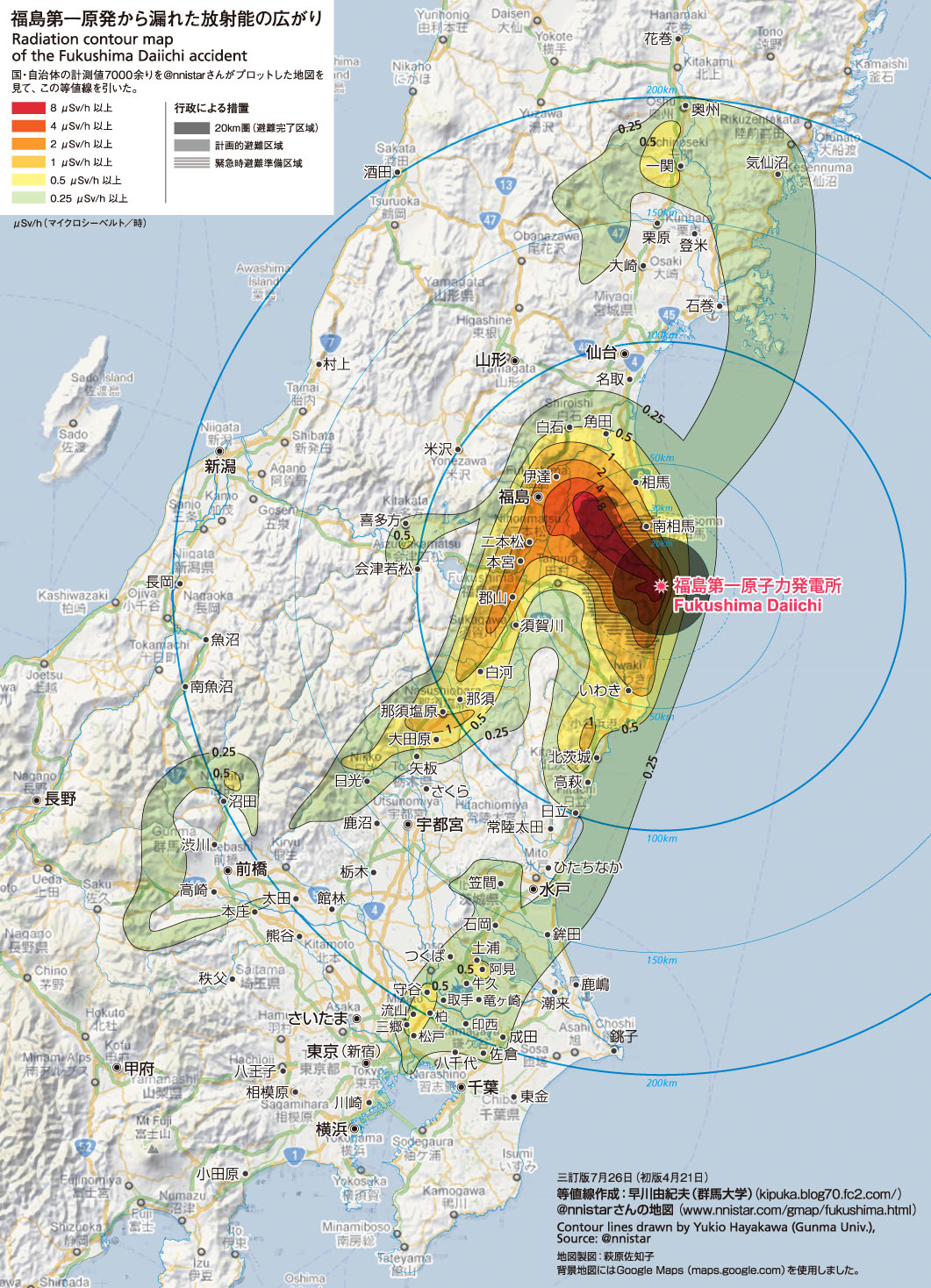
In Professor Hayakawa's map, you can see why. The area's radiation contour is at least above 0.5 microsievert/hour. (Look for the area just outside 100 kilometer radius, southwest from Fukushima I Nuke Plant.) You can view one of his photographs and see why (picture taken on July 12 at the rice field in Nasu Shiobara, air radiation level of 1.358 microsievert/hour).
Now it's a summer vacation season, and Japan's imperial families will spend the summer in imperial retreats. After the nuclear plant accident, some people have been wondering where they choose to go.
According to one journalist who follows the Japanese imperial families, "The Emperor and Empress go to the retreat in Suzaki [in Shizuoka Prefecture] and Karuizawa [in Nagano Prefecture], and the Crown Prince's family goes to the retreat in Suzaki and Nasu, in Tochigi Prefecture. It has been like that for several years now. But this year, a very high level of radiation has been detected in Nasu. So we've been wondering if they go to Nasu this year.
The Crown Princess particularly likes the Nasu retreat, and the family usually spends more than 10 days there. But there are some who voiced concern over staying in the high-radiation Nasu for an extended time, considering their daughter, Princess Aiko is only 9 years old."
The radiation level in Karuizawa is lower compared to Nasu. There were those in the Imperial Household Agency who recommended the Crown Prince's family to go to Karuizawa for the summer, but it was decided that the family would go to Nasu, just like last year.
「宮内庁幹部は、『(静養先は)例年通り。東電管内でないとまずいだろう』と話していました。
"Officials at the Imperial Household Agency were saying, "The summer retreat will be the same as last year. It cannot be outside the area served by TEPCO."
Karuizawa is the area served by Chubu Electric. When the Japanese citizens are suffering the heat of the summer in order to "conserve electricity", they may not look kindly at the Crown Prince family escaping the TEPCO area. The imperial retreat in Nasu let the earthquake/tsunami evacuees use the bath for the employees and it was very popular with the evacuees", added the same journalist.
放射能の影響が心配でないはずがないが、国民とともに歩む皇室像を貫いた、ということのようだ。
There's no way that the Crown Prince and Princess are not worried about the effect of radiation, but they [or the Imperial Household Agency] decided to portray themselves as one with the citizens of Japan.
At least some citizens of Japan would understand if they escape TEPCO, and rather have them take their young daughter to a lower radiation location and state the reason clearly - to avoid radiation.
It's not that the imperial families have much say in the matter. After all, the Kan administration sent the Emperor and Empress to Fukushima, had them eat Fukushima food and bring some as souvenirs.
I saw the article at Bloomberg Japan last night in Japanese. Here's the Bloomberg English version (7/28/2011), with some missing passages (nothing major, except for the last one) from the Japanese version:
Fukushima Teacher Muzzled on Radiation Risks for School Children
By Takahiko Hyuga
As temperatures soared to 100 degrees Fahrenheit on a recent July morning, school children in Fukushima prefecture were taking off their masks and running around playgrounds in T-shirts, exposing them to a similar amount of annual radiation as a worker in a nuclear power plant.
Toshinori Shishido, a Japanese literature teacher of 25 years, had warned his students two months ago to wear surgical masks and keep their skin covered with long-sleeved shirts. His advice went unheeded, not because of the weather but because his school told him not to alarm students. Shishido quit this week.
“I want to get away from this situation where I’m not even allowed to alert children about radiation exposure,” said Shishido, a 48-year-old teacher who taught at Fukushima Nishi High School. “Now I’m free to talk about the risks.”
After the March 11 earthquake and tsunami devastated the Tohoku region in Japan’s northeast, the central government evacuated as many as 470,000 residents, including 160,000 because of radiation risks from the crippled Dai-Ichi nuclear plant. More than 2 million residents including 271,000 children remain in Fukushima, Japan’s third-biggest prefecture by size.
The government is closely monitoring radiation levels, said Yoshiaki Ishida, an official at the Ministry of Education.
“We don’t think we are at a stage to tell Fukushima people to evacuate at this moment,” Ishida said.
Kiyoharu Furukawa, 57, assistant principal at Fukushima Nishi High, said the school told Shishido not to spend too much time talking about radiation during his classes as some students and parents complained. He confirmed Shishido resigned. ‘Invisible Snakes’
Radiation can damage human cells and DNA, with prolonged exposure causing leukemia and other forms of cancer, according to the World Nuclear Association. Children are more susceptible as their cells grow at a faster rate.
“It’s all invisible. The trees are still trees, people are shopping, the birds are singing and dogs are walking in the street,” said Chris Busby, a visiting professor at the University of Ulster’s school of biomedical sciences, who visited Fukushima prefecture last week to provide information on health risks. “When you bring out the (Geiger) machines, you can see everything is sparkling and everyone is being bitten by invisible snakes that will eventually kill them.”
Shishido will leave Fukushima for Sapporo, on the northern island of Hokkaido, on Aug. 8 to join his wife and two children aged 13 and 10, he said. The teacher aims to create a network there to help the 3,000 evacuees from Fukushima find jobs. Rent-Free Housing
Hokkaido is offering 2,140 apartments in public housing, some rent-free, to evacuees from Fukushima, Miyagi, Iwate and other prefectures affected by the quake and tsunami, said Toshifumi Imai, a Hokkaido housing official. The government also offers loans of as much as 500,000 yen ($6,400) without interest, he said.
“People in Hokkaido were supposed to take the public housing,” said Imai. “Most of them are still available.”
Shishido said he was instructed by school officials not to tell his students that they should wear masks or about how radiation would affect their health. He deleted some comments from his blog after receiving those orders in May.
“I saw little boys playing baseball in a cloud of dust, and I wondered who can protect their future,” said Kanako Nishikata, a 33-year-old housewife with a son, aged 11, and daughter, aged 8. “It’s shocking to learn a teacher is quitting because he can’t protect the students.”
A group of parents and children from Fukushima plan to visit Education Minister Yoshiaki Takaki in Tokyo on Aug. 17 to ask him to evacuate children from the prefecture, she said. Within Limits
Fukushima Nishi High, which has 873 students, had readings of 0.07 microsieverts per hour in the school building and 1.5 microsieverts per hour in the playground on July 14, still within the safety limits set by the prefecture and government, Furukawa, the assistant principal said. The school continues to hold gym classes and sports club activities outside, he said.
“I don’t think the children are safe either, and I know the radiation level is still high,” Furukawa said. “These days, they are wearing short sleeves and no masks.”
An official at the Fukushima Prefectural Board of Education, who didn’t want to be identified, said he was surprised that Fukushima Nishi High clamped down on Shishido’s views. The board has sent counselors to the 301 schools it oversees to ensure that children are not suffering from mental problems, the official said. The board also asks students and teachers to wash their hands and gargle after playing outside, the official said.
Radiation Exposure
About a fifth of the 1,600 schools in Fukushima are exposed to at least 20 millisieverts of radiation a year, the Network to Protect Fukushima Children from Radiation said, citing the most recent government readings in April. That’s the limit for an atomic plant worker set by the International Commission on Radiological Protection.
More than three-quarters of the schools receive radiation readings of 0.6 microsievert per hour, said the network, a group comprising 700 parents. That’s 10 times more than the readings in Shinjuku, central Tokyo, on average.
Miyuki Sato, a 36-year-old housewife who evacuated to Kyoto this week with her two children, attended a town hall with government officials in Fukushima on July 19. She said that even after leaving her home, she still has a 120,000 yen monthly mortgage to pay off.
“You may say we should keep children at home if we think it’s dangerous, but kids need to play outside if they want to pick flowers or collect beetles,” said the mother of a 9-year- old son and a year-old daughter. “Please get all the children out of Fukushima. Please offer financial aid for us.”
Now, on to those missing passages:
- The teacher, Mr. Shishido, had been warning his students about radiation danger UP TILL the end of May, when he was told to stop.
- An official at the Board of Education has an amusing comment about radiation. Asked by the Bloomberg reporter why he was not wearing long-sleeve shirt and a mask ("Aren't you afraid of radiation effect on health?"), he answered:
"It's just too hot to be afraid of radiation."
Fukushima is very hot during summer, that's for sure.
- Toward the end, the article quotes Miyuki Sato who evacuated to Kyoto with her children. In the English version, her words end with asking for financial help for the evacuees. Not so in the Japanese version. She does ask for all Fukushima children to be temporarily relocated and the families given financial support, but she's not specifically asking for money for her family. More importantly, she says this:
"Let me say something to people who say the radiation risk is just the matter of probabilities. Are you willing to let your children participate in a game of Russian roulette?"
That's how the Japanese version of the article ends. Mrs. Sato must have gotten a lot of flak from her neighbors for daring to move out of Fukushima. (See my post on Fukushima brainwashing.)
Also sad is the assistant principal at the high school where Mr. Shishido has taught for 25 years. He knows the radiation is high in the school yard, he knows that children should be taking precautions like wearing long-sleeve shirts and masks. But he doesn't stop the outdoor activities because the Ministry of Education says it's safe below 3.8 microsieverts/hour. Instead of telling students to take precautions the school pressured Mr. Shishido to resign, citing parents' complaints.
(Part 1, Part 2; there are also the video in 2 parts with English subtitle, French text translation, and the video in 2 parts with German subtitle. Go to this post for the links.)
Testimony by Professor Tatsuhiko Kodama of Tokyo University continues. He goes back to Minami Soma City where his Radioisotope Center has been helping to decontaminate.
We at the Radioisotope Center of Tokyo University have been helping to decontaminate Minami-Soma City, sending about 4 people at a time and doing decontamination work for the length of 700km per week.
Again, what's happening to Minami-Soma clearly shows that 20 or 30 kilometer radius [from the nuke plant] doesn't make any sense at all. You have to measure in more detail like measuring each nursery school.
Right now, from the 20 to 30 kilometer radius area, 1,700 school children are put on the buses to go to school. Actually in Minami-Soma, the center of the city is located near the ocean, and 70% of the schools have relatively low level of radiation. Yet, children are forced to get on the school buses to go all the way to schools near Iitate-mura [where radiation is higher], spending 1 million yen everyday for the busing.
I strongly demand that this situation be terminated as soon as possible.
What's most problematic is the government's policy that they will compensate the residents for the moving cost only if their areas are designated as official evacuation zones. In a recent committee held at the House of Councilors [Upper House], President Shimizu of TEPCO and Mr. Kaieda, Minister of Economy, Trade and Industry answered that way. I ask you to separate the two immediately - compensation criteria issue and children's safety issue.
I strongly ask you to do whatever you can to protect the children.
Another thing is, what I strongly feel when I'm doing the decontamination work in Fukushima is that emergency decontamination and permanent decontamination should be dealt with separately.
We've been doing a lot of emergency decontamination work. For example, if you look at this diagram, you will notice that the bottom of this slide is where small children put their hands on. Every time the rain streams down the slide, more radioactive materials accumulate. There can be a difference in radiation level between the right side and the left side. If such difference occurs and if the average radiation of the slide is 1 microsievert, then one side can measure as high as 10 microsieverts. We should do more emergency decontamination work in such places.
The ground right under the roof gutter is also where children frequently put their hands on. If you use high pressure washer you can reduce the radiation level from 2 microsieverts to 0.5 microsievert.
However, it is extremely difficult to lower the level to less than 0.5microsievert, because everything is contaminated. Buildings, trees, whole areas. You can lower radiation dose of one place, but very difficult to do that for the whole area.
Then, how much will it cost when you seriously do the decontamination work? In case of "Itai-Itai Disease" caused by cadmium poisoning, to decontaminate half of cadmium-contaminated area of roughly 3,000 hectare, the government has spent 800 billion yen so far.
How much money will be needed if we have to decontaminate the area 1,000 times as big?
Finally, Professor Kodama has 4 demands, although probably due to the time constraint he was able to elaborate only three:
So, I'd like to make four urgent requests.
First, I request that the Japanese government, as a national policy, innovate the way to measure radiation of food, soil, and water, through using the Japan's state-of-the-art technology such as semiconductor imaging detectors. This is absolutely within Japan's current technological capability.
Second, I request that the government enact a new law as soon as possible in order to reduce children's radiation exposure. Right now, what I'm doing is all illegal. The current "Radiation Damage Prevention Law" specifies the amount of radiation and the types of radionuclides that each institution can handle. Now Tokyo University is mobilizing its workforce in its twenty-seven Radioisotope Centers to help decontaminate Minami-Soma City, but many of the centers don't have a permission to handle cesium. It's illegal to transport it by cars. However, we cannot leave highly radioactive materials to mothers and teachers there, so we put them all in drums and bring them back to Tokyo. To receive them is illegal. Everything is illegal.
The Diet is to blame for leaving such situations as they are. There are many institutions in Japan, such as Radioisotope Centers at national universities, which have germanium detectors and other state-of-the-art detectors. But how can we, as the nation, protect our children if these institutions' hands are tied? This is the result of the gross negligence by the Diet.
Third, I request that the government as a national policy mobilize technological power of the private sector in order to decontaminate the soil. There are many companies with expertise of radiation decontamination; chemical companies such as Toray and Kurita, decontamination companies such as Chiyoda Technol and Atox, and construction companies such as Takenaka Corporation. Please mobilize their power to create a decontamination research center in Fukushima as soon as possible.
It will take tens of trillions of yen to do the decontamination work. I'm gravely concerned that it might become public works project involving concessions. [In other words, business as usual in Japan where only the businesses and politicians benefit.]
We don't have the luxury to spare a single second considering the financial condition of the Japanese government. We must figure out how we really do the decontamination work.
What on earth is the Diet doing, when 70,000 people are forced out of their homes and wandering?
Diposkan oleh
Pengetahuan dan Pengalaman on Thursday, July 28, 2011
(Here's Part 1, in case you missed. And Part 3. There are also the video in 2 parts with English subtitle, French text translation, and the video in 2 parts with German subtitle. Go to this post for the links.)
Part 2 of Professor Tatsuhiko Kodama's testimony on July 27 to the Committee on Welfare and Labor in Japan's Lower House in the Diet.
Professor Kodama is the head of the Radioisotope Center at the University of Tokyo.
Professor Kodama's anger is now directed toward the government's non-action to protect people, especially children and young mothers, from internal radiation exposure. His specialty is internal medicine using radioisotope, so he says he has done the intense research on internal radiation:
I have been in charge of antibody drugs at the Cabinet Office since Mr. Obuchi was the prime minister [1998-]. We put radioisotopes to antibody drugs to treat cancer. In other words, my job is to inject radioisotopes into human bodies, so my utmost concern is the internal radiation exposure and that is what I have been studying intensely.
The biggest problem of internal radiation is cancer. How does cancer happen? Because radiation cuts DNA strands. As you know, DNA is in a double helix. When it is in a double helix it is extremely stable. However, when a cell divides, the double helix becomes single strands, doubles and becomes 4 strands. This stage is the most vulnerable.
Therefore, the fetuses and small children, with cells that rapidly divide, are most susceptible to radiation danger. Even for adults, there are cells that rapidly divide such as hair, blood cells and intestinal epitheria, and they can be damaged by radiation.
Let me give you an example of what we know about internal radiation.
One genetic mutation does not cause cancer. After the initial hit by radiation, it needs a different trigger for a cell to mutate into a cancer cell, which is called "driver mutation" or "passenger mutation". (For details please refer to the attached document about the cases in Chernobyl and cesium.)
Alpha radiation is most famous. I was startled when I learned of a professor at Tokyo University who said it was safe to drink plutonium.
Alpha radiation is the most dangerous radiation. It causes thorotrast liver damage, as we, liver specialists, know very well.
Internal radiation is referred to as such-and-such millisieverts, but it is utterly meaningless. Iodine-131 goes to thyroid gland, and thorotrast goes to liver, and cesium goes to urothelium and urinary bladder. Whole body scan is utterly meaningless unless you look at these parts in the body where radiation accumulates.
Thorotrast was a contrast medium used in Germany since 1890. It was used in Japan since 1930, but it was found that 25 to 30% of people developed liver cancer 20 to 30 years later.
Why does it take so long before cancer develops? Thorotrast is an alpha-radiation nuclide. Alpha radiation injures nearby cells, and the DNA that is harmed most is P53. We now know, thanks to genome science, the entire sequence of human DNA. However, there are 3 million locations on the DNA that are different from person to person. So today, it doesn't make sense at all to proceed as if all humans are the same. The basic principle should be the "personal life medicine" when we look at internal radiation - which DNA is damaged, and what kind of change is taking place.
In case of thorotrast, it is proven that P53 is damaged in the first stage, and it takes 20 to 30 years for the 2nd, 3rd mutations to occur, causing liver cancer and leukemia.
About iodine-131. As you know, iodine accumulates in thyroid gland, and that is most noticeable during the formative phase of thyroid gland, i.e. in small children.
However, when the first researcher in Ukraine was saying in 1991 "There are an increasing number of thyroid cancer", researchers in Japan and the US were publishing articles in Nature magazine saying "There is no causal relationship between the radiation and thyroid cancer." Why did they say that? Because there was no data prior to 1986, there was no statistical significance.
The statistical significance was finally noted 20 years later. Why? Because the peak that started in 1986 disappeared. So even without the data prior to 1986, the occurrence of thyroid cancer and radiation exposure from Chernobyl had the causal relationship. Epidemiological proof is very difficult. It is impossible to prove until all the cases are done.
Therefore, from the viewpoint of "protecting our children" a completely different approach is required.
Dr. Shoji Fukushima from a national institution called Japan Bioassay Research Center, which researches health effects of chemical compounds, has been studying diseases involving urinary tract since the Chernobyl accident.
Dr. Fukushima and doctors in Ukraine studied parts of bladders removed during more than 500 cases of prostatic hypertrophy surgery. They found out that in the highly contaminated area where 6Bq/liter was detected in urine, there was a high frequency of mutation of p53 though 6Bq may sound minuscule.
They also noticed many cases of proliferative precancerous conditions, which we assume was due to the activation of p38 MAP kinase and the signal called "NF-kappa B," leading inevitably to proliferative cystitis, with carcinoma in situ occurring with considerable frequency.
Knowing this, I was astounded to hear the report that 2 to 13Bq/liter [of radioactive cesium] was detected from the breast milk of seven mothers in Fukushima.
(to be continued in Part 3.)
When radioactive materials were detected from the breast milk, what did the government and government researchers say? "No need to worry. No immediate effect on health of the babies."
Professor Kodama is saying that by the time we have proof that there is a causal relationship between internal radiation exposure (however small) and cancer, it may be too late.
Thorotrast is a suspension containing the radioactive particles of thorium dioxide.
Again, here's the video (the same one as in Part 1).
(Part 2,Part 3; there are also the video in 2 parts with English subtitle, French text translation, and the video in 2 parts with German subtitle. Go to this post for the links.)
Professor Tatsuhiko Kodama is the head of the Radioisotope Center at the University of Tokyo. On July 27, he appeared as a witness to give testimony to the Committee on Welfare and Labor in Japan's Lower House in the Diet.
Remember Professor Kosako, also from the University of Tokyo, who resigned in protest as special advisor to the prime minister over the 20 millisievert/year radiation limit for school children? There are more gutsy researchers at Todai (Tokyo University) - the supreme school for the "establishment" - than I thought. Professor Kodama literally shouted at the politicians in the committee, "What the hell are you doing?"
He was of course referring to the pathetic response by the national government in dealing with the nuclear crisis, particularly when it comes to protecting children.
Even if you don't understand the language, take a look and listen. He sounds sincere, and his voice is literally shaking with anger.
(The original video that was embedded in this post was removed at Youtube. Too many views for TPTB, maybe. It was approaching 300K views. This one is missing the first few minutes, and starts when he talks about 5 microsieverts/hour in Tokai-mura.)
Aside from his anger, he also gave some very interesting and disturbing information, which I try to summarize below:
He starts out with the radiation fallout in Tokyo:
"We detected 5 microsieverts/hour radiation in Tokai-mura in Ibaraki Prefecture about 9AM on March 15, and notified the Ministry of Education and Science as the "Article 10 notification" [as specified in the Nuclear Disaster Countermeasures Law]. Later, the radiation exceeding 0.5 microsievert/hour was detected in Tokyo. Then on March 22 it rained in Tokyo, and with the rain came 0.2 microsievert/hour radiation, and this I believe is the reason for the elevated radiation level to this day.
"Chief Cabinet Secretary Edano said at that time, "There is no immediate effect on health". I actually thought this was going to be a big, big problem."
It was indeed in the news that 5 microsieverts/hour radiation was detected at Tokai-mura in Ibaraki Prefecture on March 15 morning, but hardly anyone, other than nuclear experts like him, connected that news with the elevated radiation level in Tokyo. The residents of Tokyo didn't even know about it. What happened in the morning of March 15? Well, Reactor 4 at Fukushima I Nuclear Power Plant had a "big noise" which blew out the roof at 6AM, and Reactor 2 had an explosion in the Suppression Pool at 6:14AM. Or it could be from the Reactor 3 explosion in the previous day, at 11:01AM on March 14.
The professor goes on to explain his concern at that time:
"Why was I concerned? Because the current radiation injury prevention method is based on dealing with a small amount of radioactive materials that emit very high radiation. In this case, the total amount of radioactive materials is not much of an issue. What matters is how high the radiation is.
"However, in the case of the Fukushima I Nuclear Power Plant accident, 5 microsieverts within 100-kilometer radius [he is referring to Tokai-mura], 0.5 microsievert within 200-kilometer radius [referring to Tokyo area], and the radiation extended far beyond, even to teas in Ashigara and Shizuoka, as everybody now knows."
So, instead of a small amount of highly radioactive materials in a confined area, what we have is a huge amount of radioactive materials spread wide.
He continues:
"When we research the radiation injury/sickness, we look at the total amount of radioactive materials. But there is no definite report from TEPCO or the Japanese government as to exactly how much radioactive materials have been released from Fukushima.
"So, using our knowledge base at the Radioisotope Center, we calculated. Based on the thermal output, it is 29.6 times the amount released by the nuclear bomb dropped on Hiroshima. In uranium equivalent, it is 20 Hiroshima bombs.
"What is more frightening is that whereas the radiation from a nuclear bomb will decrease to one-thousandth in one year, the radiation from a nuclear power plant will only decrease to one-tenth.
"In other words, we should recognize from the start that just like Chernobyl, Fukushima I Nuke Plant has released radioactive materials equivalent in the amount to tens of nuclear bombs, and the resulting contamination is far worse than the contamination by a nuclear bomb."
So what's the implication of the huge amount of radioactive materials released and dispersed wide? It's much harder to predict the behavior of the particles, as they behave in a non-linear manner:
"When a vast amount of radioactive materials is released, they are in particles. Dispersion of particles is non-linear, and it's one of the most difficult calculations in the fluid dynamics. The nuclear fuel is like sands buried in synthetic resin, but once the fuel melts down, a large amount of super-fine particles is released.
"What happens then? The problem like the contaminated rice hay happens. The pattern of contamination does not follow concentric circles. It depends on the weather. It also depends on where the particles landed - on the material that absorbs water, for example."
His Radioisotope Center has been helping Minami Soma City, and he describes the situation in the city in details concerning the radioactive rice hay:
"We at the Radioisotope Center have been helping Minami Soma City in the decontamination effort. We've done seven decontaminations so far. When we went to Minami Soma for the first time, there was only one geiger counter. On March 19 when the Ministry of Agriculture, Forestry and Fisheries supposedly issued the notice [on the cattle feed], food, water, and gasoline were about to be depleted in the city. The mayor of Minami Soma made a plea for help on the Internet, which was widely viewed.
"In that kind of situation, no one would look at a piece of paper from the Ministry, no one would know. Farmers didn't know that rice hay was in danger. Still, they bought the feed from abroad, paying hundreds of thousands of yen, and started to feed the cows with the same groundwater that they drank.
"So, what should we do now? We have to guarantee that the thorough radiation measurement is done in the contaminated area. As I said before, there was only one geiger counter in Minami Soma City when we went there in May. In fact, there were 20 personal survey meters provided by the US military. But no one at the city's Board of Education could understand the English manual until we went there and told them how to use them. That's how it is there.
"As to the food inspection, there are more advanced survey meters than germanium counters, such as semiconductor detectors. Why doesn't the Japanese government spend money in supporting [the development of these advanced detectors?]?
"After 3 months, the government has done no such thing, and I am shaking with anger."
Diposkan oleh
Pengetahuan dan Pengalaman on Wednesday, July 13, 2011
From a blog by a father in Fukushima who wanted to send his children and his wife for the summer to Shizuoka Prefecture:
Apparently Fukushima had a program that helped the Fukushima residents to escape Fukushima during the school summer vacation (July, August) by subsidizing the cost of the hotels and bed and breakfast places (called "pension" in Japan, just like in continental Europe) in participating prefectures.
This father had booked a pension in Shizuoka Prefecture, and was looking forward to sending his kids to a lower radiation location (well, relatively speaking, at this point). Then, he suddenly got a call from the pension, on July 12, and was told they had to cancel his reservation because they received a notice from Fukushima Prefecture not to accept temporary summer evacuees from Fukushima.
WTF? (He said in a more polite Japanese, but that's the idea.)
Why on earth Fukushima would want to do this? To irradiate children more? he wonders, and remembers Dr. Shunichi Yamashita, who was on the radio all the time in Fukushima preaching safety ever since the nuke accident started on March 11 which totally brainwashed the residents in Fukushima.
So he tried a hotel in another part of Shizuoka to see if he could make a reservation. The answer was no. But he found out from the hotel people that the pension that had canceled his reservation and others like that in that particular city had been booking the temporary evacuees from Fukushima without approval from the local government.
[WTF? Why do these private businesses need the government approval to receive customers?]
So he decided to find out what was going on. And he's found out:
The temporary summer evacuation will have to be approved, from now on, by both Fukushima Prefecture and Shizuoka Prefecture, and it will be approved only for people who are considering permanent evacuation due to high radiation levels.
Fukushima Prefecture is not banning the evacuation that the residents do on their own (i.e. without any government subsidy), but it wouldn't recommend such a move.
Fukushima Prefecture has stopped the subsidy program for the temporary summer evacuation. The hotels and pensions that had been accepting the temporary summer evacuees from Fukushima will not receive subsidy any more that allowed for a lower room rate for the Fukushima evacuees, therefore they are canceling the reservations made under the program.
In addition, Fukushima Prefecture has asked other prefectures to shut down the evacuation shelters for Fukushima residents by the end of this month, citing the reason as "temporary housing within Fukushima Prefecture available".
He's still looking for a place to send his kids and his wife for the lower-radiation summer somewhere. But since the subsidy has been cut off, not many places are willing to take reservations.
Is there anyone in Japan, or anywhere in the world for that matter, willing to take his family for the summer? And many others like them?