Showing posts with label radioactive fallout. Show all posts

Japan's Idea of Decontamination: Give Manual to Citizens and Let Them Do It

Diposkan oleh Pengetahuan dan Pengalaman on Tuesday, August 30, 2011

So the vast tract of East Japan has been contaminated with radioactive materials that came out of nuclear fuel rods that were melted down (and through and possibly out), and many areas are more contaminated than the radiation control area of a nuclear power plant which requires strict control and decontamination by nuclear professionals in case of an accident.


So what have the affected municipalities done? Fukushima Prefecture already has a handbook for citizens on how to decontaminate. The national government has promised it will come up with a plan. (It reminds me of "Blackadder" - where Baldrick always say to Blackadder at the very last moment, "I have a cunning plan ..." which is not cunning and usually very bad or useless or both to say the least.)


That national plan may be something like the one that has been apparently released by the Japanese Society of Radiation Safety Management, and it relies on the citizens' effort to locate the high radiation "hot spots" and decontaminate using the household cleaning tools and materials, as if radioactive cesium and strontium and plutonium and cobalt should be no different from dirt and rust.


One great thing about this citizen decon idea is that it won't cost much at all to the national government, other than some support money given to neighborhood associations.


Asahi Shinbun (8/31/2011) reports:

個人の住宅周辺で特に放射線量が高い「ホットスポット」の見つけ方と、効果的な除染法について、日本放射線安全管理学会がマニュアルをまとめた。雨どいの下など、放射性物質が集まりやすい場所を紹介。放射性物質が飛散しない除染法なども説明している。


The Japanese Society of Radiation Safety Management has created a manual on how to find "hot spots" in and around one's home and how to decontaminate effectively. The manual shows the locations where radioactive materials tend to accumulate, such as under the rain gutters, and explains the methods of decontamination that do not spread radioactive materials.


 ホットスポットは、雨どい▽側溝▽排水溝▽マンホール周辺▽水たまりの乾燥跡▽さびた鉄材▽切り株や木材▽草木やこけの表面▽枯れ葉や土がたまった場所――などに多く見つかる。


[According to the manual,] hot spots are often found at rain gutters, side drains, manholes, locations where there were water puddles, rusted metals, tree stumps and lumber, surface of grass, trees and moss, pile of fallen leaves and dirt.


 雨どいや屋根の材質がさびたトタンや凹凸が激しい瓦の場合、セシウムが吸着しやすい。ちりや枯れ葉を掃除して集めると、線量が数十倍になることもある。


Cesium tends to adhere to the rain gutters, rusted tin roofs, and roofing tiles with uneven surface. If one sweeps dust and fallen leaves and collect them, the radiation level may jump significantly.


 家庭菜園で、3月中旬~下旬以降に枯れ葉などですき込み作業をした場合は、作物への放射性物質の移行に注意が必要という。


If dead leaves were plowed into the home garden after mid March, one should be aware that radioactive materials may have moved to the plants.


 屋根や雨どいを除染する場合はブラシを用い、汚れが落ちにくい場合は重曹水や酢を2~3倍に薄めた水を少しかけてこする。さびた部分は、オレンジクリーナーやクレンザーなどを使うと効果的だという。


According to the manual, one should use a brush to decontaminate the roof and rain gutters. If the dirt doesn't come off easily, one may wet the surface a little with water with baking soda or with vinegar and scrub. Cleanser is effective on rusty parts.
More aboutJapan's Idea of Decontamination: Give Manual to Citizens and Let Them Do It

13% of Radioactive Iodine, 22% of Radioactive Cesium from Fukushima I Nuke Plant Landed in Central/Northern Japan

Diposkan oleh Pengetahuan dan Pengalaman on Thursday, August 25, 2011

The rest was either blown off to the ocean or landed somewhere else in Japan.


Researchers at the National Institute of Environmental Studies (NIES) had their paper published in the electronic version of "Geophysical Research Letters" published by the American Geophysical Union on August 11, and they announced the result of their research in Japan on August 25.


The paper was submitted on June 27, and they kept quiet until the research was published. The researchers at this government institute therefore knew all along how bad the contamination was all over southern Tohoku and all of Kanto and part of Chubu.


Abstract of the paper titled "Atmospheric behavior, deposition, and budget of radioactive materials from the Fukushima Daiichi nuclear power plant in March 2011" by Yu Morino, Toshimasa Ohara,* and Masato Nishizawa, Regional Environment Research Center, National Institute for Environmental Studies, 16-2, Onogawa, Tsukuba, Ibaraki, 305-8506, Japan:

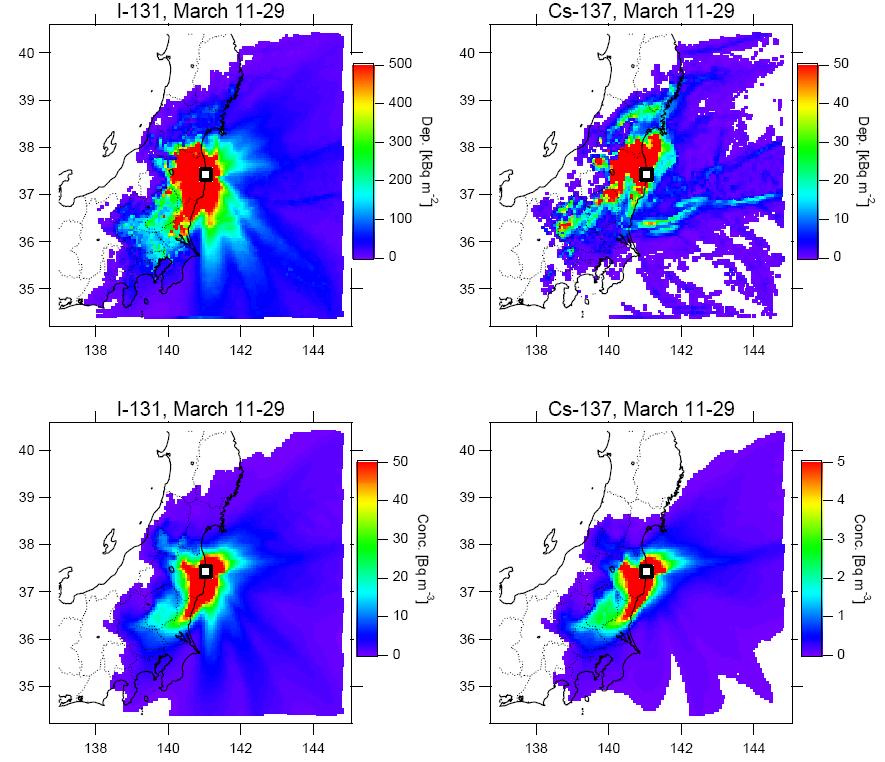
To understand the atmospheric behavior of radioactive materials emitted from theFukushima Daiichi nuclear power plant after the nuclear accident that accompanied the great Tohoku earthquake and tsunami on 11 March 2011, we simulated the transport and deposition of iodine-131 and cesium-137 using a chemical transport model. The model roughly reproduced the observed temporal and spatial variations of deposition rates over 15 Japanese prefectures (60–400 km from the plant), including Tokyo, although there were some discrepancies between the simulated and observed rates. These discrepancies were likely due to uncertainties in the simulation of emission, transport, and deposition processes in the model. A budget analysis indicated that approximately 13% of iodine-131 and 22% of cesium-137 were deposited over land in Japan, and the rest was deposited over the ocean or transported out of the model domain (700 × 700 km2). Radioactivity budgets are sensitive to temporal emission patterns. Accurate estimation of emissions to the air is important for estimation of the atmospheric behavior of radionuclides and their subsequent behavior in land water, soil, vegetation, and the ocean.

No other nuclides are discussed in the paper. But just for these two, if you look at the deposition and concentration simulation maps below, you see that at least half Fukushima Prefecture is "red", not just along the coast, which means the highest deposition of both iodine-131 and cesium-137 in high concentration. Southern Miyagi is just as bad as Fukushima , so is part of Ibaraki and Tochigi.


From their paper (page 19) - top row is the cumulative surface deposition amount of iodine-131 and cesium-137 from March 11 to 29; the bottom row is the average concentration of iodine-131 and cesium-137, again from March 11 to 29:


Now that their paper has been safely published, I wonder if these researchers will speak up (or the government will allow them to speak up) on the subject of radioactive contamination in much of Tohoku and Kanto. I doubt it, but I hope so. I wish they had spoken up much earlier, but I understand that having their paper published by a prestigious foreign academic society is very important for a scientific researcher.

(While I do understand the restriction on the researchers like not allowing them to publish the data before the paper is peer-reviewed and published, but I do wonder if the academic society or the magazine would have given them some sort of waiver. The paper was not about Chernobyl cesium deposition 25 years after people were evacuated from the area; it is about an on-going disaster where many people's lives may be at stake. Oh well.)

More about13% of Radioactive Iodine, 22% of Radioactive Cesium from Fukushima I Nuke Plant Landed in Central/Northern Japan

Another "Baseless Rumor": Cicadas in Japan This Summer Have Been Awfully Quiet

Diposkan oleh Pengetahuan dan Pengalaman on Thursday, August 18, 2011

(Warning: Photos may be too disturbing to some people.)


This is one of those bits of information that people in Japan have been exchanging on the social media since the beginning of summer: "I don't hear cicadas this year".


A typical summer in Japan is hot and humid (except in a few lucky places like Hokkaido), and the air is filled with the "singing" of cicadas.


But this year, people report that cicadas are either extremely quiet or totally silent in large part of Japan. The exception seems to be the Kansai area, but almost everywhere else people say they don't hear cicadas, and it's been a strangely quiet summer.


It is quite possible that it's been like that every year and people have started to pay heightened and nervous attention to the nature around them after the nuclear accident.


But some people have started to post the photos of cicadas they've found this summer. No wonder they don't "sing". Again, it is quite possible that cicadas in Japan have been malformed for a long time and people have just started to notice, and it's nothing to do with radiation.


Picture of a cicada supposedly taken 60 kilometers from Fukushima I Nuke Plant, on July 22:


A cicada 120 kilometers from the plant. The person who took the photo says on her August 15 blogpost that it was on the ground and trying to flap its wings, and died soon:


Cicadas 300 kilometers from the plant. The person who took the photo says in her blog that in normal year about 100 cicadas hatch in her garden between mid July and mid August but this year the hatching peaked out in early August. He/she also says the male to female ratio is very lopsided this year (way more females than males, and only males "sing" to attract females), and he/she's found 8 cicadas so far that were unable to get out of the shells and died before they could hatch. In a normal year, he/she finds only one or two that fail to hatch and die.


He/she suspects these cicadas may have gotten their radioactive nutrition from the roots of the trees that have been absorbing radioactive materials since the nuke accident. Radioactive fallout like radioactive cesium cannot have penetrated deep enough into the ground to affect cicadas directly.


Cicadas spend between 3 to 17 years underground before they hatch and live a brief summer. Some say only a week, others say as long as one month.


There is another possibility why cicadas are quiet, and that's not good either. It is said in the folklore that the summer before a big earthquake hits is very quiet without hardly any cicadas.

More aboutAnother "Baseless Rumor": Cicadas in Japan This Summer Have Been Awfully Quiet

#Radioactive Fallout in Tokyo in March: Iodine, Cesium, Tellurium, Radioactive Silver

Diposkan oleh Pengetahuan dan Pengalaman on Monday, August 1, 2011

Silver-110m, half life about 250 days, wouldn't have been discovered unless the control rods had melted at Fukushima I Nuclear Power Plant.

There was the news in early April that radioactive silver was detected in South Korea. There was no way the same nuclide wasn't falling in Japan if it could fly all the way to Korea, I thought.

Sure enough.

It was not until 2PM on July 29 that the Ministry of Education and Science announced the "reading of environmental radioactivity level by prefecture [Fallout]" for March 2011.

What's the point of telling us now? Just for the record?

Radioactive materials that were falling in the Kanto region in March, other than iodine-131, cesium-134 and -137, are:

Niobium-95
Tellurium-129
Tellurium-129m
Tellurium-132
Silver-110m
Cesium-136
Lantanium-140
Barium-140

They look to be the nuclides coming out of melted fuel rods. No plutonium, strontium or uranium are mentioned.

The level of radioactive iodine (131) and cesium (134, 137) is also markedly high in Kanto. It is particularly high in Tochigi and Ibaraki Prefectures, and it is higher in Tokyo than in Saitama or Chiba. The area with the elevated level of radioactive fallout includes Shizuoka and Nagano Prefectures. For details for other prefectures, please go to the Ministry of Education website.

March result (part):

More about#Radioactive Fallout in Tokyo in March: Iodine, Cesium, Tellurium, Radioactive Silver