Showing posts with label cesium-137. Show all posts

Amount of Radioactive Cesium in Urine Increased in a Boy Who Remained in Fukushima

Diposkan oleh Pengetahuan dan Pengalaman on Wednesday, September 7, 2011

From Jiji Tsushin (9/7/2011):

市民団体「福島老朽原発を考える会」などは7日、尿検査で放射性セシウムが検出された福島市などの子ども10人を2カ月後に再調査したところ、他県に避難しなかった1人で数値が減少せず、微増したと発表した。

A citizen's group (福島老朽原発を考える会) announced the result of the second testing of the 10 children in Fukushima City and other locations whose urine had been tested 2 months earlier. In one child who did not evacuate from Fukushima, the amount of radioactive cesium didn't decrease but increased slightly.

 同会などは5月、フランスの放射線計測機関に依頼して6~16歳の男女10人の尿を検査し、全員からセシウムを検出。7月末に再調査した結果、県外に避難した9人は数値が下がったり、検出されなくなったりしたが、福島市に残った16歳の少年はセシウム137が1リットル当たり0.78ベクレルから同0.87ベクレルに増えたという。

In May, the group asked a French laboratory to test the urine samples from 10 children from 6 to 16 years old. Radioactive cesium was detected from all samples. In the second test conducted at the end of July, the amount was lower, or in some cases not detected, in 9 children who evacuated from Fukushima Prefecture. However, from the urine sample of a 16-year-old boy who remained in Fukushima City, cesium-137 increased from 0.78 becquerels/liter in May to 0.87 becquerels/liter.

France's ACRO, who did the testing, has more details and harsh words for the Japanese government (emphasis is original):

Comments :

At the request of Japanese citizens, ACRO analyzed the urine of 18 Japanese children from the prefecture of Fukushima and from Tokyo and its surroundings.

All the 15 children from Fukushima have or had their urine contaminated with radioactive fallout from the nuclear accident located approximately 60 km away. This means that children themselves have been or are contaminated. However, we did not detect any contamination in the urine of the three children from Tokyo and surroundings.

While the tests performed by the Japanese authorities give about one child from Fukushima out two that is contaminated, we get 100%. This reflects the fact that the official measurements are not accurate enough and did not detect all contaminations.

The first 10 children are the same as in our previous measurement campaign (results released June 30). 9 of them have left the province of Fukushima since. Only one remained (U2).
U6 child was evacuated in end of March. U3 and U4 children were evacuated in the end of May. 3 left late June, early July and three others at the beginning of the school holidays from July 22.

Finally, five new children live nearby Fukushima-city. One of them was evacuated in the middle of May (U14).

U11 and U12 attend the same high school where they frequently practice sports on the same playground. The difference in the contamination could be due to food.

More than four months after the massive discharges of radioactivity into the environment, all children still in Fukushima at the time of urine sampling were contaminated, although their parents do their best to reduce this contamination. Evacuation is a way to reduce contamination. Variations in internal contamination between different children might be due to food.

It is important to conduct an accurate, systematic and regular monitoring of internal contamination of children from Fukushima. Families must have access to the measurement of radioactivity to help them reduce this contamination.

(H/T 44de256)

More aboutAmount of Radioactive Cesium in Urine Increased in a Boy Who Remained in Fukushima

Simulation Map of Cesium-137 Deposition Across the Pacific by CEREA Shows Contamination in US Greater Than That of Western Japan

Diposkan oleh Pengetahuan dan Pengalaman on Wednesday, August 31, 2011

France's CEREA has the simulation map of ground deposition of cesium-137 from the Fukushima I Nuclear Power Plant accident on its "Fukushima" page. It not only shows Japan but also the entire northern Pacific Rim, from Russian Siberia to Alaska to the West Coast of the US to the entire US.


According to the map, the US, particularly the West Coast and particularly California, may be more contaminated with radioactive cesium than the western half of Japan or Hokkaido. It looks more contaminated than South Korea or China. Canada doesn't look too well either, particularly along the border with US on the western half.


From CEREA's Fukushima page:

Atmospheric dispersion of radionuclides from the Fukushima-Daichii nuclear power plant


CEREA, joint laboratory École des Ponts ParisTech and EdF R&D

Victor Winiarek, Marc Bocquet, Yelva Roustan, Camille Birman, Pierre Tran


Map of ground deposition of caesium-137 for the Fukushima-Daichii accident.


The simulation was performed with a specific version of the numerical atmospheric chemistry and transport model Polyphemus/Polair3D. The parametrisations used for the transport and physical removal of the radionuclides are described in [1,2,3,4].


The magnitude of the deposition field is uncertain and the simulated values of deposited radionuclides could be significantly different from the actual deposition. In particular, the source term remains uncertain. Therefore, these results should be seen as preliminary and they are likely to be revised as new information become available to better constrain the source term and when radionuclides data can be used to evaluate the model simulation results.

The page also has the animated simulation of cesium-137 dispersion from March 11 to April 6, 2011. If the Japanese think they are the only ones who have the radiation and radioactive fallout from the accident, they are very much mistaken, if the simulation is accurate. (Meteorological institutes and bureaus in Austria, Germany, and Norway all had similar simulation maps.)


Radioactive materials spewed out of Fukushima I Nuke Plant went up and away on the jet stream, reaching the other side of the Pacific. When the fallout from explosions (March 14, 15) reached the US West Coast, it came with an unusually heavy rainfall in California.

CEREA's description of the animation (if the animation doesn't work, or if you want to see the bigger one, go to CEREA's page):

Movie of the Fukushima-Daichii activity in the air (caesium-137, ground level)

The simulation was performed with a specific version of the numerical atmospheric chemistry and transport model Polyphemus/Polair3D. The parametrisations used for the transport and physical removal of the radionuclides are described in [1,2,3,4].


The magnitude of activity concentration field is uncertain and could be significantly different from the actual one. In particular, the source term remains uncertain. Therefore, these results should be seen as preliminary and they are likely to be revised as new information become available to better constrain the source term and when radionuclides data can be used to evaluate the model simulation results.


(Go to their page to see the references.)

More aboutSimulation Map of Cesium-137 Deposition Across the Pacific by CEREA Shows Contamination in US Greater Than That of Western Japan

Soil Contamination in 34 Locations in Fukushima Exceeds Chernobyl Confiscation/Closed Zone Level

Diposkan oleh Pengetahuan dan Pengalaman on Monday, August 29, 2011

In one location, the contamination level is more than 10 times the Chernobyl level.


What a surprise. Now that PM Kan is out, the government dribbles out the information that it withheld as it de-emphasized and even attacked the reports of high soil contamination as measured by private entities including citizens' groups.


The most contaminated location found so far is Okuma-machi, where Fukushima I Nuke Plant is located: 29,460,000 becquerels per square meter with cesium-134 and cesium-137 combined, 15,450,000 becquerels per square meter if only cesium-137 is counted.


The confiscated/closed zone after the Chernobyl accident is set in locations whose cesium-137 level in soil exceeds 1,480,000 becquerels per square meter. The level of cesium-137 in the location in Okuma-machi is 10 times that of the Chernobyl confiscated/closed zone.


From Yomiuri Shinbun (3:05AM JST 8/30/2011):

東京電力福島第一原子力発電所事故で拡散した放射性物質による土壌汚染の状態を調べた地図がまとまり、29日に開かれた文部科学省の検討会で報告された。


The soil contamination as the result of the Fukushima I Nuclear Power Plant accident was reported on the August 29 meeting at the Ministry of Education and Science.


 立ち入りが制限されている警戒区域や計画的避難区域で、チェルノブイリ原発事故での強制移住基準(1平方メートル当たりの放射性セシウム137が148万ベクレル)を超える汚染濃度が測定されたのは、6市町村34地点に上った。住民の被曝(ひばく)線量などを把握するのが狙い。菅首相が27日、「長期間にわたり住民の居住が困難になる地域が生じる」との見通しを示したが、それを裏付けた。


The survey found 34 locations in 6 municipalities exceeding the level of the confiscation/closed zone of the Chernobyl accident (1,480,000 becquerels/square meter of cesium-137 in soil). The purpose of the survey was to understand the radiation exposure of the residents. Prime Minister Kan said on August 27 that there might be locations where the residents wouldn't be able to return for a long time. The survey data validates the prime minister's comment.


 測定結果によると、6月14日時点で、セシウム137の濃度が最も高かったのは、警戒区域内にある福島県大熊町の1平方メートル当たり約1545万ベクレル。セシウム134と合わせると、同約2946万ベクレルとなった。


According to the survey, the highest cesium-137 concentration in soil as of June 14 was in Okuma-machi in Fukushima Prefecture, within the no-entry evacuation zone, at 15,450,000 becquerels/square meter. If combined with cesium-134, the radioactive cesium concentration was 29,460,000 becquerels/square meter.


 同300万ベクレル超となったのは、セシウム137で同町、双葉町、浪江町、富岡町の計16地点に上った。高い濃度の地点は、原発から北西方向に延びており、チェルノブイリ事故の強制移住基準を超える地点があった自治体は、飯舘村、南相馬市を加えた計6市町村だった。同省は約2200地点の土壌を測定した。


Total 16 location in 4 municipalities (Okuma-machi, Futaba-machi, Namie-machi, Tomioka-machi) exceeded 3,000,000 becquerels/square meter in cesium-137 concentration. The area with the high cesium-137 concentration extends northwest from the nuclear power plant. In total, 6 municipalities including Iitate-mura and Minami Soma City had the locations that exceeded the Chernobyl confiscation/closed zone level of cesium-137. The Ministry measured the soil samples from about 2,200 locations.

Here's the map by Asahi Shinbun, including the locations with cesium-137 concentration of less than 1 million becquerels/square meter.


More aboutSoil Contamination in 34 Locations in Fukushima Exceeds Chernobyl Confiscation/Closed Zone Level

13% of Radioactive Iodine, 22% of Radioactive Cesium from Fukushima I Nuke Plant Landed in Central/Northern Japan

Diposkan oleh Pengetahuan dan Pengalaman on Thursday, August 25, 2011

The rest was either blown off to the ocean or landed somewhere else in Japan.


Researchers at the National Institute of Environmental Studies (NIES) had their paper published in the electronic version of "Geophysical Research Letters" published by the American Geophysical Union on August 11, and they announced the result of their research in Japan on August 25.


The paper was submitted on June 27, and they kept quiet until the research was published. The researchers at this government institute therefore knew all along how bad the contamination was all over southern Tohoku and all of Kanto and part of Chubu.


Abstract of the paper titled "Atmospheric behavior, deposition, and budget of radioactive materials from the Fukushima Daiichi nuclear power plant in March 2011" by Yu Morino, Toshimasa Ohara,* and Masato Nishizawa, Regional Environment Research Center, National Institute for Environmental Studies, 16-2, Onogawa, Tsukuba, Ibaraki, 305-8506, Japan:

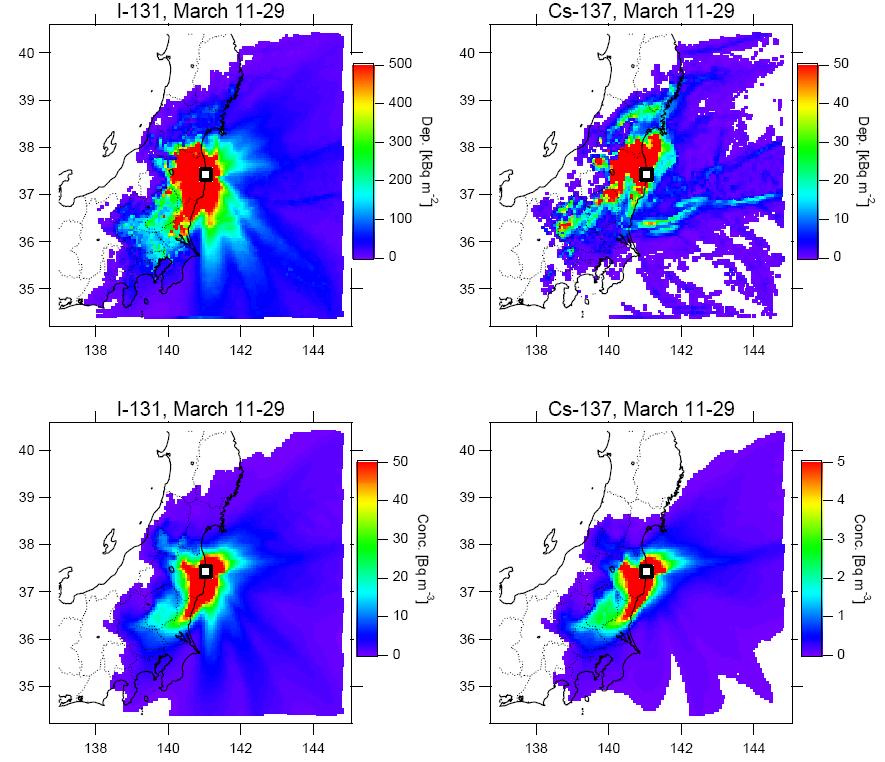
To understand the atmospheric behavior of radioactive materials emitted from theFukushima Daiichi nuclear power plant after the nuclear accident that accompanied the great Tohoku earthquake and tsunami on 11 March 2011, we simulated the transport and deposition of iodine-131 and cesium-137 using a chemical transport model. The model roughly reproduced the observed temporal and spatial variations of deposition rates over 15 Japanese prefectures (60–400 km from the plant), including Tokyo, although there were some discrepancies between the simulated and observed rates. These discrepancies were likely due to uncertainties in the simulation of emission, transport, and deposition processes in the model. A budget analysis indicated that approximately 13% of iodine-131 and 22% of cesium-137 were deposited over land in Japan, and the rest was deposited over the ocean or transported out of the model domain (700 × 700 km2). Radioactivity budgets are sensitive to temporal emission patterns. Accurate estimation of emissions to the air is important for estimation of the atmospheric behavior of radionuclides and their subsequent behavior in land water, soil, vegetation, and the ocean.

No other nuclides are discussed in the paper. But just for these two, if you look at the deposition and concentration simulation maps below, you see that at least half Fukushima Prefecture is "red", not just along the coast, which means the highest deposition of both iodine-131 and cesium-137 in high concentration. Southern Miyagi is just as bad as Fukushima , so is part of Ibaraki and Tochigi.


From their paper (page 19) - top row is the cumulative surface deposition amount of iodine-131 and cesium-137 from March 11 to 29; the bottom row is the average concentration of iodine-131 and cesium-137, again from March 11 to 29:


Now that their paper has been safely published, I wonder if these researchers will speak up (or the government will allow them to speak up) on the subject of radioactive contamination in much of Tohoku and Kanto. I doubt it, but I hope so. I wish they had spoken up much earlier, but I understand that having their paper published by a prestigious foreign academic society is very important for a scientific researcher.

(While I do understand the restriction on the researchers like not allowing them to publish the data before the paper is peer-reviewed and published, but I do wonder if the academic society or the magazine would have given them some sort of waiver. The paper was not about Chernobyl cesium deposition 25 years after people were evacuated from the area; it is about an on-going disaster where many people's lives may be at stake. Oh well.)

More about13% of Radioactive Iodine, 22% of Radioactive Cesium from Fukushima I Nuke Plant Landed in Central/Northern Japan