Showing posts with label iodine-131. Show all posts

Radioactive Iodine in Sewer Sludge in Oshu City, Iwate

Diposkan oleh Pengetahuan dan Pengalaman on Wednesday, September 7, 2011

Oshu City is located 187 kilometers north of Fukushima I Nuclear Power Plant.

The city announced the latest survey of radioactive materials in sewer sludge in a sewage treatment center in the city, and it shows iodine-131 being detected in the sludge cake since August 25.

From the city's announcement on September 7 (original in Japanese, I translated the dates, etc.; emphasis is mine):

Collection date


Testing date


I-131

Cs-134

Cs-137

Cs-Total

7/7/2011

7/14/2011

ND

81

100

181

7/21/2011

7/23/2011

ND

71

64

135

7/28/2011

7/30/2011

ND

58

79

137

8/4/2011

8/7/2011

ND

38

76

114

8/11/2011

8/12/2011

ND

33

52

85

8/25/2011

8/27/2011

2,300

47

52

99

8/31/2011

9/2/2011

590

20

57

77

9/6/2011

9/6/2011

480

82

96

178


The city says it has stopped the shipment of sludge cakes from this plant because of the high radioactive iodine concentration detected from the August 25 sample, but that the sludge cakes have been used as fertilizer material because the amount of radioactive cesium has been below the provisional safety limit for composts and manures (400 becquerels/kg).
More aboutRadioactive Iodine in Sewer Sludge in Oshu City, Iwate

13% of Radioactive Iodine, 22% of Radioactive Cesium from Fukushima I Nuke Plant Landed in Central/Northern Japan

Diposkan oleh Pengetahuan dan Pengalaman on Thursday, August 25, 2011

The rest was either blown off to the ocean or landed somewhere else in Japan.


Researchers at the National Institute of Environmental Studies (NIES) had their paper published in the electronic version of "Geophysical Research Letters" published by the American Geophysical Union on August 11, and they announced the result of their research in Japan on August 25.


The paper was submitted on June 27, and they kept quiet until the research was published. The researchers at this government institute therefore knew all along how bad the contamination was all over southern Tohoku and all of Kanto and part of Chubu.


Abstract of the paper titled "Atmospheric behavior, deposition, and budget of radioactive materials from the Fukushima Daiichi nuclear power plant in March 2011" by Yu Morino, Toshimasa Ohara,* and Masato Nishizawa, Regional Environment Research Center, National Institute for Environmental Studies, 16-2, Onogawa, Tsukuba, Ibaraki, 305-8506, Japan:

To understand the atmospheric behavior of radioactive materials emitted from theFukushima Daiichi nuclear power plant after the nuclear accident that accompanied the great Tohoku earthquake and tsunami on 11 March 2011, we simulated the transport and deposition of iodine-131 and cesium-137 using a chemical transport model. The model roughly reproduced the observed temporal and spatial variations of deposition rates over 15 Japanese prefectures (60–400 km from the plant), including Tokyo, although there were some discrepancies between the simulated and observed rates. These discrepancies were likely due to uncertainties in the simulation of emission, transport, and deposition processes in the model. A budget analysis indicated that approximately 13% of iodine-131 and 22% of cesium-137 were deposited over land in Japan, and the rest was deposited over the ocean or transported out of the model domain (700 × 700 km2). Radioactivity budgets are sensitive to temporal emission patterns. Accurate estimation of emissions to the air is important for estimation of the atmospheric behavior of radionuclides and their subsequent behavior in land water, soil, vegetation, and the ocean.

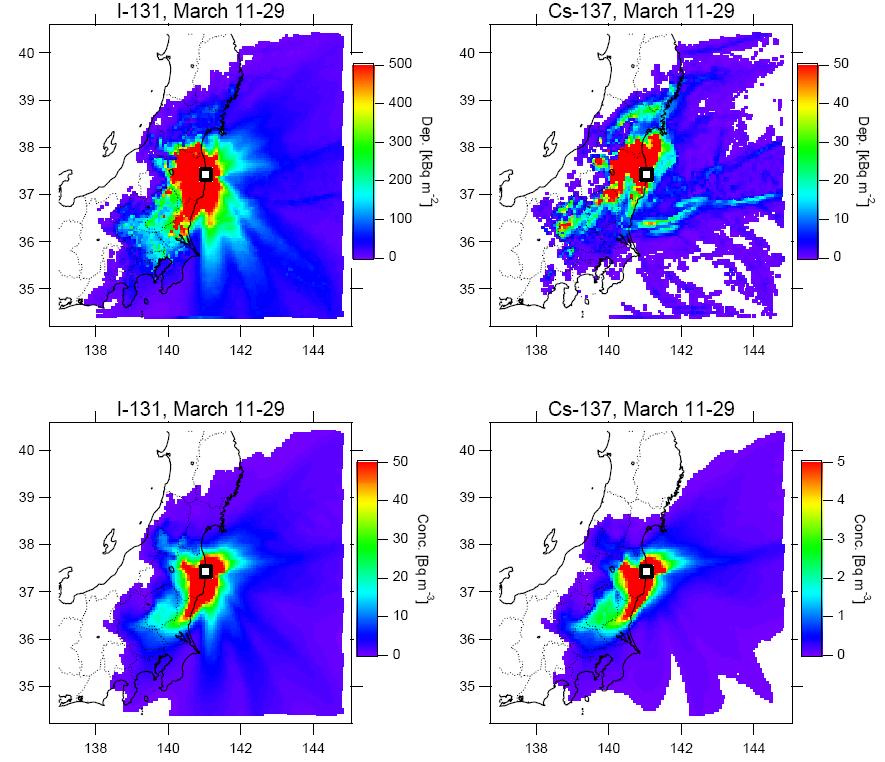
No other nuclides are discussed in the paper. But just for these two, if you look at the deposition and concentration simulation maps below, you see that at least half Fukushima Prefecture is "red", not just along the coast, which means the highest deposition of both iodine-131 and cesium-137 in high concentration. Southern Miyagi is just as bad as Fukushima , so is part of Ibaraki and Tochigi.


From their paper (page 19) - top row is the cumulative surface deposition amount of iodine-131 and cesium-137 from March 11 to 29; the bottom row is the average concentration of iodine-131 and cesium-137, again from March 11 to 29:


Now that their paper has been safely published, I wonder if these researchers will speak up (or the government will allow them to speak up) on the subject of radioactive contamination in much of Tohoku and Kanto. I doubt it, but I hope so. I wish they had spoken up much earlier, but I understand that having their paper published by a prestigious foreign academic society is very important for a scientific researcher.

(While I do understand the restriction on the researchers like not allowing them to publish the data before the paper is peer-reviewed and published, but I do wonder if the academic society or the magazine would have given them some sort of waiver. The paper was not about Chernobyl cesium deposition 25 years after people were evacuated from the area; it is about an on-going disaster where many people's lives may be at stake. Oh well.)

More about13% of Radioactive Iodine, 22% of Radioactive Cesium from Fukushima I Nuke Plant Landed in Central/Northern Japan

Arnie Gundersen: "On-and-Off Recriticality Possible in Reactor 3"

Diposkan oleh Pengetahuan dan Pengalaman on Monday, June 6, 2011

I was listening the podcast of the interview Arnie Gundersen gave to Chris Martenson the other day (in order to translate into Japanese) and noticed something I had missed when I skimmed through the transcript for my post.

Gundersen is saying that 10% of the fuel core of the Reactor 3 may be repeating a re-criticality, on and off:

"Unit 3 may not have melted through and that means that some of the fuel certainly is lying on the bottom, but it may not have melted through and some of the fuel may still look like fuel, although it is certainly brittle. And it's possible that when the fuel is in that configuration that you can get a re-criticality. It's also possible in any of the fuel pools, one, two, three, and four pools, that you could get a criticality, as well. So there’s been frequent enough high iodine indications to lead me to believe that either one of the four fuel pools or the Unit 3 reactor is in fact, every once in a while starting itself up and then it gets to a point where it gets so hot that it shuts itself down and it kind of cycles. It kind of breathes, if you will.

"I think it's a relatively significant amount – maybe a tenth of the nuclear reactor core starts back up and shuts back down and starts back up and shuts back down. And that’s an extra heat load; you are not prepared to get rid of one tenth of a nuclear reactor’s heat by pumping water in the top."

Hiroaki Koide of Kyoto University suspected an on-and-off recriticality in the Reactor 1 back in early April when TEPCO announced, supposedly erroneously, chlorine-38 was detected. Dr. Tetsuo Matsui of Tokyo University suspected recriticality in the Reactor 2 and/or the Reactor 4 Spent Fuel Pool. Gundersen suspects an on-and-off recriticality in the Reactor 3 (or any of the Spent Fuel Pools).

Below is the chart of iodine-131 detection at the Federal Office of Radiation Protection in Germany, plotting the CTBTO station data from around the world. Station 38 is Takasaki, Gunma Prefecture in Japan, 218 kilometers (135 miles) from Fukushima I Nuclear Power Plant. I always thought it was rather peculiar that there seemed to be periodic spikes in the amount of iodine-131 (also of cesium-137 but to a lesser degree) followed by a relatively calm, steady decline.

Could these spikes indicate what Gundersen is talking about? On-and-off recriticality?


More aboutArnie Gundersen: "On-and-Off Recriticality Possible in Reactor 3"

#Fukushima I Nuke Accident: NISA Now Says 1.31 Million Becquerel Iodine-131 Was Detected on March 15, 38 Kilometers from the Plant

Diposkan oleh Pengetahuan dan Pengalaman on Friday, June 3, 2011

It was not just the tellurium-132 data that the Japanese government hid.

The national government and the Fukushima prefectural government had the data that showed 1,230,000 becquerels/kilogram iodine-131 was detected from the grass on March 15 in Kawamata-machi, 38 kilometers from Fukushima I Nuclear Power Plant.

They sat on it. It didn't occur to them to disclose, said NISA's Nishiyama. His subordinate at NISA further commented, as seen in the news clip on NHK Japanese, "It is not clear that the data would have helped at all, even if it had been disclosed."

Tell that to parents in Fukushima and elsewhere.

By the way, Kawamata-machi is where the residents in the areas closer to the plant intially evacuated, including the residents in Iitate-mura and Namie-machi.

From NHK Japanese (4:32AM JST 6/4/2011):

... 公表されていなかったのは、避難や飲食物の摂取制限など、住民の防護対策を決める際の参考にするため、発電所周辺で国や福島県によって行われた「緊急時モ ニタリング」のデータの一部です。

Part of the "emergency monitoring data" collected by the national government and the Fukushima prefectural government around the nuclear plant wasn't disclosed [until June 3]. The data was to be used for protection of the residents, such as evacuation and restriction on food and water consumption.

このうち、大気中のちりなどに含まれる放射性物質の調査では、事故の翌日の3月12日午前8時半すぎに発電所からおよそ 7キロの浪江町の地点で、核燃料が溶けた際に出るテルルと呼ばれる放射性物質が1立方メートル当たり73ベクレル検出されていました。

In the survey of radioactive materials in the dust particles in the air, 73 becquerels/kilogram of tellurium was detected at 8:30AM on March 12 at a location 7 kilometers from the power plant in Namie-machi. Tellurium is one of the radioactive materials released when the nuclear fuel melts.

このデータが検出さ れる3時間ほど前、政府は避難区域を発電所の3キロから10キロ以内に拡大し、住民に避難を呼びかけていましたが、燃料の損傷の説明はなく、その後、昼す ぎに行われた原子力安全・保安院の会見でも、核燃料は壊れていないと説明していました。深刻な事態が進みつつあることを示すデータが早い段階で公表されて いれば、住民の避難のしかたや避難への心構えなどに役立てられた可能性がありますが、原子力安全・保安院は「データがどれだけ住民のために役立てられたか は現時点では分からない」としています。

3 hours before tellurium was detected, the national government expanded the evacuation zone from 3-kilometer radius from the plant to 10-kilometer radius, and was asking the residents to leave. But there was no mention of the damage to the fuel. In the press conference that afternoon, the Nuclear and Industrial Safety Agency said the nuclear fuel was not damaged. If the data had been disclosed at an early stage when a serious situation was developing, the data might have been useful in evacuating the residents or better informing the residents. However, NISA claims "It is not known at this point how useful the information would have been to help the residents."

一方、事故発生の4日後に周辺の市町村で行った放射性物質の調査のうち、原発から30キロから50キロの4か所で 採取した雑草などのデータも公表されていませんでした。このうち、原発の北西およそ38キロの川俣町で採取した雑草からはヨウ素131が1キログラム当た り123万ベクレルという高い濃度で検出されていました。

Meanwhile, of the survey done in cities, towns, and villages around the nuclear plant 4 days after the start of the accident, the data on the grass taken at 4 locations 30 to 50 kilometers from the plant wasn't disclosed. The withheld data shows a high concentration (1,230,000 becquerels/kilogram) of iodine-131 was detected from the grass in Kawamata-machi, 37 kilometers northwest of the plant.

原発周辺の雑草については、この調査から9日後になって初めて飯舘村で1キログラム当たり252 万ベクレルの放射性ヨウ素が検出されたと発表されていました。

About the grass in the area around the plant, it was announced [on March 24] that 2,520,000 becquerels/kilogram of radioactive iodine was detected in Iitate-mura, 9 days after [the data in Kawamata-machi was taken].

これについて、環境中の放射性物質に詳しい学習院大学の村松康行教授は「放射性ヨウ素は子ど もへの影響が大きく最も注意が必要な物質だ。早い段階で遠くまで放射性ヨウ素の汚染が広がっていることが公表されていればより早く何らかの対応ができた可 能性がある。当時の対応を検証する必要がある」と指摘しています。

Professor Yasuyuki Muramatsu of Gakushuin University, an expert in environmental radiation, points out, "Radioactive iodine affects children the most and we should monitor it very carefully. If the extent of contamination of radioactive iodine in places far away from the plant was disclosed early on, we could have done something about it. We need to examine the government response at that time."

データの公表が遅れたことについて、原子力安全・保安院は「対策本部を現地から福島県庁 に移す際に混乱したため、データがあることは把握していたが、公表しようという考えに至らなかった。深く反省している」と話しています。

About the delay in disclosing the data, NISA says, "There was a confusion when we moved the headquarters [to deal with the accident] from the plant to the Fukushima prefectural government hall. We knew there was such data, but it never occurred to us to disclose it. We deeply regret."

"Delay" is an understatement. And it is clear that it was a selective amnesia; they picked the worst data and hid it.

The government also "forgot" to disclose the simulation data that were created in case of an accident at Fukushima II Nuclear Power Plant, according to NHK.

More about#Fukushima I Nuke Accident: NISA Now Says 1.31 Million Becquerel Iodine-131 Was Detected on March 15, 38 Kilometers from the Plant