Showing posts with label AP. Show all posts

A Solitary Farmer in Tomioka-Machi: "I'll Never Leave, I'll Never Be Beaten"

Diposkan oleh Pengetahuan dan Pengalaman on Friday, September 2, 2011

AP News reported on August 31 about Mr. Naoto Matsumura, who refuses to leave his home and his farm in Tomioka-machi, which lies in the no-entry evacuation zone within the 20 kilometer radius from Fukushima I Nuclear Power Plant. His family has farmed in that location for 5 generations.


"I'll never be beaten", he says. If he wants to stay, it's his right to do so, he also says.


(h/t Irene)

More aboutA Solitary Farmer in Tomioka-Machi: "I'll Never Leave, I'll Never Be Beaten"

AP: "Quake risk to reactors greater than thought"

Diposkan oleh Pengetahuan dan Pengalaman

"Gov't says 27 US reactors could be more vulnerable to earthquakes than previously thought", according to the article on 9/2/2011.


From AP:

WASHINGTON (AP) -- The risk that an earthquake would cause a severe accident at a U.S. nuclear plant is greater than previously thought, 24 times as high in one case, according to an AP analysis of preliminary government data. The nation's nuclear regulator believes a quarter of America's reactors may need modifications to make them safer.


The threat came into sharp focus last week, when shaking from the largest earthquake to hit Virginia in 117 years appeared to exceed what the North Anna nuclear power plant northwest of Richmond was built to sustain.


The two North Anna reactors are among 27 in the eastern and central U.S. that a preliminary Nuclear Regulatory Commission review has said may need upgrades. That's because those plants are more likely to get hit with an earthquake larger than the one their design was based on. Just how many nuclear power plants are more vulnerable won't be determined until all operators recalculate their own seismic risk based on new assessments by geologists, something the agency plans to request later this year. The NRC on Thursday issued a draft of that request for public comment.


The review, launched well before the East Coast quake and the Japan nuclear disaster in March, marks the first complete update to seismic risk in years for the nation's 104 existing reactors, despite research showing greater hazards.


The NRC and the industry say reactors are safe as they are, for now. The average risk to U.S. reactors of core damage from a quake remains low, at one accident every 500 years, according to the AP analysis of NRC data.


The overall risk at a typical reactor among the 27 remains very slight. If the NRC's numbers prove correct, that would mean no more than one core accident from an earthquake in about 30,000 years at the typical reactor among the 27 with increased risk.


But emails obtained in a more than 11,000-page records request by The Associated Press show that NRC experts were worried privately this year that plants needed stronger safeguards to account for the higher risk assessments.


(The article continues.)

What's more interesting than the article is the comment section. Here are some:

- I am suspicious of the anti-nuclear propaganda like this article. Not one person died due to the Japanese nuclear problem. Millions of people die worldwide each year due to pollution from coal and oil fired power plants. ... Nuclear power does not produce CO2. It is the ONLY source powerful enough to supply our modern world. Solar and wind are great - but much too small a source. ...The hysteria over nuclear must stop. Every power source has its problems. Nuclear will not kill the five or six billion eventually that scientists say will happen with increasing CO2.


- That's right- Hack Journalist! Blow Me AP! You fear mongoring POS! DIE AP!


- So a bunch of hack journalists read a bunch of government emails and that makes them nuclear engineers?Give me a freaking break!

You can read the rest of the comments at the link.

More aboutAP: "Quake risk to reactors greater than thought"

Made-In-Japan Robot "Quince" Joined the Also-Failed at #Fukushima I Nuke Plant

Diposkan oleh Pengetahuan dan Pengalaman on Friday, June 24, 2011

Kurion's water treatment system underperformed by a vast margin, T-Hawk crashed on the roof of the Reactor 2 building, and now the Japanese robot "Quince" got caught in a bad juju at Fukushima I Nuclear Power Plant.

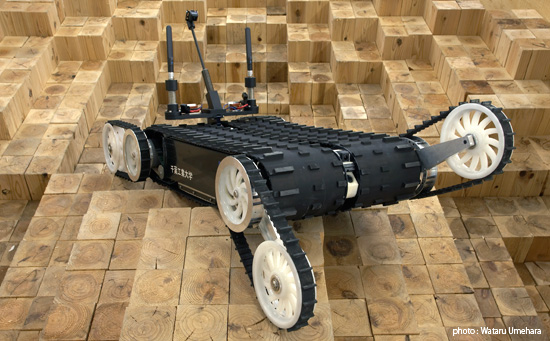
"Quince" was designed and developed by Chiba Institute of Technology, and was going to install the water gauge for the highly contaminated water (radiation near the surface of water was 430 millisieverts/hour the other day) in the basement of the Reactor 2's reactor building.

(Photo is from CIT's site. You can see how it is supposed to work here on Youtube.)

Quince tried to go there in the morning of June 24, but it got stuck in the stairway leading to the basement, and had to be retrieved by the carbon-based workers.

From AP Tokyo (6/24/2011):

The Quince robot, developed by Chiba Institute of Technology for nuclear and biological disaster relief activity, had ventured out into the Unit 2 reactor building to set up a gauge to measure the contaminated water pooling in the basement. Radioactivity inside the reactor buildings is too high for workers to take measurements there.

The machine got stuck at a staircase landing and failed to go downstairs, TEPCO spokesman Junichi Matsumoto said. A cable that was supposed to drop a gauge into the basement also malfunctioned.

The workers retrieved the robot and were going to make adjustments before sending it back in for another try, Matsumoto said. He did not elaborate.

TEPCO's handout for the press doesn't make any mention of it, although it does mention the crashed T-Hawk.

By the way, the above AP article, just like any other reports by the Japan-based media, continues to say:

TEPCO and the government have said they hope to achieve a cold shutdown of the reactors by January by bringing the core temperatures to below 100 Celsius (212 Fahrenheit.)

A "cold shutdown" cannot even be defined for a broken reactor where the fuel core had melted away along with control rods and other in-vessel equipment and got out of the Reactor Pressure Vessel and probably out of the Containment Vessel. The RPV is broken, and so is the Containment Vessel. Sure, TEPCO measures temperature of the RPVs, but what does that mean, when the corium is already out of the RPVs? How could a temperature of a broken RPV be an indication for a "cold shutdown"? Do they know how hot the escaped corium is, or where exactly the corium is right now?

Do reporters ask such questions?
More aboutMade-In-Japan Robot "Quince" Joined the Also-Failed at #Fukushima I Nuke Plant